The biggest problem with FNAF is that it has yet to officially end, because, for every new instalment that has been added to the series since the original game, it keepings losing more and more focus of what its original identity even was (there is one caveat to this, but I will get to that later). In FNAF 1, the lore was simple: five children had gone missing and were presumed dead, and, although the suspect was charged, the bodies were never found. As it would turn out, the killer had hidden the bodies in the animatronic suits of the main attractions. As a result of this, the animatronics came to be possessed by the souls of the missing children, which is why they attack the player, in an attempt to get revenge. It was a simple but effective story to not only hook the player into the game but to also provide an explanation for why the animatronics were trying to kill the player. In contrast, what even is the FNAF lore at this point? How did it come to deviate so far from this simple premise, when that premise should have been what took centre stage? Was it not because of that very premise that FNAF got as popular as it is now? The answer is that Scott made the lore too convoluted for the sake of making it convoluted, which resulted in the initial premise being left forgotten in favour of trying to unravel the finer details.
Unlike what many might claim, this trend did not start with Sister Location but started instead as early as FNAF 2. On initial inspection, it would seem like FNAF 2 was destined to be a sequel to FNAF 1. However, when the game was released, this was revealed to not have been the case. FNAF 2 was not a sequel but was instead a prequel to FNAF 1. Although the evidence for why this is the case is certainly definitive, I was never a fan of this being the correct answer, because all it ultimately did was to dilute the story. By introducing this red herring, the story was stripped of all its emotional weight, because instead of treating the tragedy that had occurred in the original game with the respect and gravitas it deserved, like how it was originally treated, all attention was diverted towards what the timeline of event was. Ever since this shift in priority occurred, no one seems to really be able to take the murder of five children seriously, which is a real shame because not only was that the original premise of the entire story but it was also why the original game still has the best atmosphere. This did not happen as a result of Steel Wool taking over production, nor as a result of Sister Location releasing. No, this happened as early as FNAF 2, the second game in the entire series, during a time when the timeline was thought to be much more focused than it is today, when it is supposedly not as focused as it was during the release of FNAF 2.
I do not necessarily intend to put all the blame squarely on Scott, even if it was ultimately his decision to remove focus from the initial premise and to therefore strip the story of all its emotional weight by introducing unnecessarily complex plot points. With that being said, I believe an equally, if not grater blame, could be put on us fans, because the reason Scott decided to make the lore even more convoluted in FNAF 3 was because he realised that we loved FNAF 2 for being more convoluted than FNAF 1. If only we had rejected the lore added in FNAF 2 for being unnecessarily convoluted, Scott would have never tried to make the lore in FNAF 3 even more convoluted than FNAF 2 and would have instead dialled it back to the way it was in FNAF 1. In other words, because Scott wanted to please us, and because we clearly wanted a never-ending mystery, that is what we received, which is why the lore is as convoluted as it currently is and is also the reason why FNAF did not end after UCN: because Scott understood that there was still an unsatiated demand for FNAF lore and, being the kind-hearted person he is, decided to give us exactly what we wanted by continuing the story of FNAF.
It is for these reasons I very much do not like it when people accuse Scott of "milking the series," because that is clearly not the case. I am sure that he likes making bank, and even though Scott has admitted during the first interview he did with Dawko, that the original intention for FNAF 1 was simply to make some extra money to pay the bills with, I do not believe that remained the only or even the most dominant intention for this series after the success of FNAF 1. Because, if all Scott was doing was simply milking the series, then why had he, after the release of FNAF 2, planned to have ended it with the following game? Would he not have tried to milk it harder, instead of ending it when FNAF was at its peak of popularity? If all Scott wanted was to make more money, why did he, after receiving heavy backlash for FNAF World having been released unfinished, take it down from Steam and request for Steam to allow anyone, regardless of how much they had played, to request a full refund for it, only to, then, release it for free on GameJolt? Also, why would he have released Pizzeria Simulator or UCN for free if he was milking the series? Maybe he was simply happy that, after having spent two whole decades making game without much success, people were finally playing and enjoying his games.
Out of all theories to have been made about FNAF, there is only one that people actively want to not be true: Dream Theory. This is because people thought everything except for FNAF 4 being rendered a dream would render the emotional weight of the first three games insignificant. This is not entirely incorrect, but it is also not defensible. This is because, as I have already explained, FNAF 2 already rendered the emotional weight established in FNAF 1 insignificant by focusing on the timeline rather than the tragedy of the murders. As such, the argument that FNAF 4 rendered the emotional weight of the story insignificant is simply not true. What is, however, true is that FNAF 4 did indeed invalidate the fanbase's efforts in trying to piece together the timeline of the first games, since, if they were nothing more than the product of the Crying Child's nightmares, what was even the point in trying to figure out the timeline? Although I can understand this certain frustration, I frankly do not care. As should be obvious by now, I do not care for the timeline discourse, because it strips the story of its emotional weight, which is bad storytelling, as any writer can attest to, because it makes it basically impossible for people to care about the story and the character. As such, I really do not care if FNAF 4 invalidated the fanbase's efforts in trying to solve the timeline, because that never interested me, in the first place. What peeked my interest in FNAF was how raw FNAF 1 felt, in both its lore and atmosphere. Everything about it, from the animatronics to the settings, feels like a decrepit relic stuck in the past, unable to move on. Then, FNAF 2 and 3 ruined the series by not having this atmosphere and placing all importance on some timeline. But, then, FNAF 4 was released, and it made me care about the story again, precisely because it rendered the timeline irrelevant, which gave the story its much needed emotional weight by making the entire lore of FNAF centred around the tragic life of a small, young child who was being tormented by his older brother during the day for being the only one who was afraid of the animatronics, only to, then, also be tormented by the animatronics he feared in his sleep. There was no rest for him. No escape from the nightmare. And, then, he dies, on his very own birthday, all because he was afraid of the animatronics. In my opinion, there are only three instances of good storytelling in FNAF: FNAF 1, FNAF 4, and Henry's speech in Pizzeria Simulator. The rest is simply not good. Although most do agree that Henry's speech is probably the best piece of writing in FNAF, most also seem to not regard FNAF 1 and 4 with the same level of respect, if any, at all. It seems like most do not care for FNAF 1 because it has already been solved and do not care for FNAF 4 because it convolutes too much (I sure do wonder why). From my perspective, it does not seem like these people care about actual, quality writing, because, if they did, they would also agree with me that FNAF 4's story was good. But they do not, because they do not care about the story or its emotional weight. All they care about is the timeline, which, as I have already admitted, FNAF 4 does indeed render irrelevant, which is why they dislike FNAF 4 and Dream Theory. However, it is also for these reasons I really do not care for the direction Scott decided to take with FNAF when he saw the fanbase's reaction to Dream Theory and realised that what the fanbase want is not a good story but a convoluted puzzle that will never end.
As should be obvious by now, I very much like Dream Theory, and I am glad that it was Scott's original intention for FNAF 4 because that means that I can not only ignore everything that FNAF 2 and 3 introduced to dilute to story but also ignore everything that comes after FNAF 4 and pretend FNAF ended with FNAF 4, like Scott had intended for it to do, before he decided to retcon Dream Theory after the backlash he received for it. What irritates me somewhat is when people try to deny that Dream Theory was ever the original intention for FNAF 4, when it very clearly was, only because they hate the thought of it so much that they would rather that the theory had never been canon. To clarify, I do not think Dream Theory is currently canon, nor do I expect the reader to change his mind about Dream Theory being bad if he dislikes it, but what I would expect the reader to do is to admit, either now or at the end of this section, that Dream Theory was indeed the original intention for FNAF 4 before it was later retconned in Sister Location due to backlash. That is all that I demand.
To understand why this was the case, it would be wise to first provide the reader with some much needed context, since I do not suppose he spends his free time watching a decade old videos on FNAF. FNAF 4 was released on July 23rd, 2015. On the 25th August of the same year, Scott would make this post on the Steam forums about the Halloween update for FNAF 4. In the last paragraph, Scott claims that not a single person had managed to solve FNAF 4 before the making of this post, which surprised him, because, his last game, FNAF 3, had been solved within 24h, as a result of data-scraping. I will be returning to this post later (a lot). In response to this post, MatPat decided to host a livestream on September 3rd, and with the help of some of the biggest YouTubers in the FNAF community that he had invited on, hopefully solve FNAF 4. The only problem was that this livestream was riddled with technical difficulties so bad that they never managed to make new grounds or, really, discuss anything. Worse, yet, it was unfortunately never archived. In an attempt to try again, MatPat decided to host a second livestream on September 18th. This livestream, on the other hand, is available on YouTube and is the "livestream" I will be referencing continuously throughout this section of the essay (if you can even call this one section and not simply "the essay" itself). During this, the second, livestream, Scott decided to take pity on them (because there was still technical difficulties) and decided to give them something to chew on by updating his website three times. For each update, Scott would make a different statement relating to FNAF 4. When presented with these statements, MatPat postulated a new theory that has come to be known as "Dream Theory," which I strongly recommend the reader to actually watch before reading any further if the last time he watched this video was 10 years ago. This is the origin story of Dream Theory. From this, it is possible to conclude a very important detail that is often times not known: because Dream Theory was presented after Scott made the post claiming that no one had solved FNAF 4, that post could not have been, inter alia, referring to Dream Theory, which means that Scott has never officially debunked Dream Theory, which, alone, refutes 50% of all attempts to "debunk" Dream Theory. This, alone, should also tell the reader the level of logic we are going to be operating on.
However, there are those who still disagree. In this video made by Nickolops, he claims, at 21:46, that because it is possible to find traces of people discussing Dream Theory before Scott made his post, it must mean that Dream Theory cannot be true. Similarly, I have seen others claim that because some people speculated that the character we control during the gameplay section could be the Crying Child before Scott made his post, it must mean that Dream Theory cannot be true, because, in-order for Dream Theory to be true, the character we control during the gameplay section must be the Crying Child. The problem with both of these statements is that if absolutely everything stated about FNAF 4 prior to Scott making that post can be deemed "incorrect," then absolutely every single theory about FNAF 4, including the ones that they want to be correct, automatically becomes incorrect. For example, according to those who oppose Dream Theory, the character we control during the gameplay section is not the Crying Child but is instead his older brother. The only problem with this is that, according to their very own logic, because it is also possible to find traces of people speculating that the character we play as during the gameplay section is the older brother before Scott made his post, it must mean that we cannot play as the older brother during the gameplay section. To further demonstrate how flawed their logic truly is, if, as Scott claims, that FNAF 1-3 had been solved but FNAF 4 had not been, and if this means that everything stated about FNAF 4 prior to this post was therefore rendered incorrect, then that must mean that everything stated about FNAF 1-3 prior to this post, including things that obviously make no sense, must also be correct. But does the reader want to know the best part of this entire argument made by Nickolops? It is that, at 38:12, he directly refutes himself by admitting that people were already speculating that we play as the older brother during the gameplay section prior to Scott's post on the Steam forums.
What Scott meant by that post was not that everything stated about FNAF 1-3 was correct, only that he had seen a theories that had solved them, like how he mentions how MatPat did an incredible video on FNAF 2. Likewise, what Scott meant by that post was not that everything stated about FNAF 4 was incorrect, only that he had yet to see a theory solve it. For example, in Matpat's first video on FNAF 4, which was released prior to Scott's post, MatPat claims that the character we play as during both the gameplay and mini-game sections cannot be the victim of the bite of '87 because science. The reason why Scott declared this video "wrong" was not because everything MatPat stated in his video was wrong but rather because his general thesis was wrong. There are two reasons for this. Firstly, we do not play as the victim of the bite of '87 but instead as the victim of the bite of '83. Secondly, even though MatPat does claim that the gameplay section of FNAF 4 was a nightmare experienced by the Crying Child, he fails to induce that this suggests that all previous games were nothing more than the product of the Crying Child's nightmares as well. This is true for Nickolops as well. At 22:14, when Nickolops shows the post made prior to Scott's post talking about "Dream Theory," there is no mention of the idea that all the previous games could have also been nightmares. All that is stated is that FNAF 4 is a "coma-induced nightmare." However, if I were to be incredibly pedantic (which I should be allowed to be, since that is how those who oppose Dream Theory treat Dream Theory), although this idea is treated as gospel by the community, it is never actually explicitly stated anywhere in FNAF 4 that the Crying Child is in a coma, only that he is in the hospital. But I digress. What I believe is that what Scott wanted us to figure out was that not only was the gameplay section of FNAF 4 a nightmare experienced by the Crying Child but all other games as well. That is why the three statements made by Scott during the livestream very explicitly hint towards all previous games having been nightmares experienced by the Crying Child, because that was what Scott thought the fanbase had failed to realise. If this were not the case, the reader is more than welcome to try to resolve the objectively impossible logic error in the previous paragraph.
The other, more important aspect to consider is that whilst Scott did indeed directly interact with the fanbase on Reddit back then, it does not mean that Scott was acutely aware of everything that was posted about FNAF on the entire internet. That would simply be absurd. In other words, if someone made a post on an obscure website detailing Dream Theory in a way that would have satisfied Scott, there is absolutely no reason to assume Scott would have seen this, because Scott would not have been able to fine comb the entire internet for a theory that would have solved the lore of FNAF 4 prior to making his post, to the point that he was aware of the existence of a post with only 4 likes, which, for all we know, could have been zero at the time and would only come to amass that meagre number over time, ever since it was made in 2015. No, he probably just watched the most popular YouTuber's videos on FNAF, like MatPat and Dawko (both of whom Scott has admitted to watching), read a couple of threads on Reddit, and concluded that no one had solved it. As such, when Scott stated that "no one had solved it," he merely meant "I have yet to see a theory that solves it." To assume he was talking in absolute terms, or that, even if he did not intend to, that his statement should be read in absolute terms, is absurd, because, in-order to do that, you would have to be able to prove that Scott did indeed fine comb the entire internet before making this post, which is an impossibility. Because, guess what? If even NEETs who do nothing but waste away their lives on a certain Mongolian basket weaving forum cannot even manage to read all the posts made on their homeboard, how do you expect Scott, who had two children and was working on the Halloween update for FNAF 4, to have the time to scour the entire internet? Get real.
As stated in the opening of this section, the original intention for FNAF 4 was Dream Theory, which, then, got retconned by Sister Location. So far, I have disproven the idea that Scott has ever officially debunked Dream Theory, which means that this thesis is, at the very least, not incorrect. However, if what I am attempting to do is to conclusively prove that Dream Theory was the original intention for FNAF 4, having disproven the idea that it was ever officially debunked by Scott is not the same as having proved it to have been the original intention. First and most straightforward of all, if Scott has never officially debunked Dream Theory, has he ever officially confirmed Dream Theory to have been the original intention? No, not explicitly, but he has pretty much confirmed it based on circumstantial evidence. In his first interview with Dawko, Scott explains, at 36:30, that the contents of the box has changed over the years, and that the reason he decided to change the contents of the box was because of people's reaction (to it). Despite not explicitly stating that what he was referring to was the reaction to Dream Theory, it is possible to infer from previous context that he was specifically referring to the reaction to FNAF 4, because, at 34:50, he explicitly states that he was left unsatisfied with the reaction to the story of FNAF 4. In case the reader is not aware because he was not there at the time, people only started to react negatively to the story of FNAF 4 after the release of MatPat's video on Dream Theory, when it became undeniable that Dream Theory had been the original intention.
Before that, people were simply confused, not unsatisfied, like Scott claimed they had been, because, in-order to become unsatisfied, you first have to learn what the true answer is and realise that no other answer other than it could be the right one. Otherwise, it would simply be possible to keep looking, which the community was no stranger to, even back then. But that is not what people did, because the evidence for Dream Theory having been the original intention was and still is overwhelming in its favour, which left people unsatisfied, because they did not like Dream Theory. But they did not deny it having been the original intention. They simply did not like it. Seeing this, seeing that people had solved the mystery but had been left unsatisfied with the answer, Scott decided to retcon Dream Theory, because he did not want FNAF 4 (which he had hoped would be well enough received so that the series would have been able to end on a good note instead of having ended on a bad note, like it had done with FNAF 3, when that was supposed to be the end of the original trilogy) to once again end on a bad note with FNAF 4. If this were not the case, if Dream Theory had not been the original intention, why did Scott not simply leave a comment on the video debunking it, like he had done on MatPat's first video on FNAF 4, as MatPat claims, at 1:14, he had done in his second video on FNAF 4 (the one he made before Dream Theory)? There is certainly an argument to be made that this was because Scott did not want to interfere more than he had already done by making his three statements, as seems to have been the reason why he decided to delete that comment. However, even if Scott did not want to interfere more than he had already done, if absolutely everyone hated Dream Theory and were convinced that it was true, and it just so happened to not have been the correct answer, would it not have made far more sense for Scott to simply have debunked it, regardless, if he had wanted the series to end with FNAF 4, instead of making an entirely new game to retcon a theory that was never the original intention?
It is for these reasons that Scott explains, at 35:59, that he felt the need to ground the lore again, "not necessarily in reality, but I need to ground it in kind of storytelling again." In case it was not already obvious, his desire of wanting to "ground" the story is a fairly peculiar choice of words if by "ground" he had simply meant, "tell a story that was not 'too broad for interpretation,'" like he claims FNAF 4 had been at 35:13. If, as I believe, Scott's original intention for FNAF 4 was Dream Theory, which is a story that inherently makes the story of FNAF not grounded in reality, since it was all a dream, it would make sense why he accidentally let the term "ground" slip, only to quickly correct himself after having said so, so as to not reveal too much, because, when he was thinking about where FNAF 4 had gone wrong, it would make sense for him to think about Dream Theory, since that was what people were not happy with. This is why he used the term "grounded," because when he was reflecting on where FNAF 4 had gone wrong, he must have thought about how the story had not been grounded enough in reality, which is why he would quickly try to muddy the waters by adding, "not necessarily in reality," in-order to avoid making it too obvious that he was referring to Dream Theory, despite neither of them having even remotely referenced Dream Theory, because that was what Scott was thinking about when he was thinking about how he wanted to write a better story that the fanbase would accept.
Despite my intent to, it is impossible to conclusively prove that Dream Theory was the original intention of FNAF 4, and that it was later retconned with the release of Sister Location. The only way to conclusively prove such a thing would be for Scott himself to confirm that FNAF 4 was retconned, which he has not explicitly done. He has, on the other hand, confirmed that throughout the original four games, he has only done one retcon, and that this retcon was seamlessly integrated, which means that the retcon he was referring to cannot have been referring to him retconning Dream Theory, because that retcon, as the reader will no doubt soon understand, was not integrated seamlessly, in any capacity whatsoever, but left instead a very distinct mark on the lore. If it was not already obvious, I do not trust Scott when he says that he has only ever done one retcon, because I do not trust that his definition of what a "retcon" is is the same as the standard definition of it. What I think Scott means by retcon is not that he has changed the story, because the story, within the span of the first four games, changed four times, but that he instead wrote something out of the story. For example, I and a large portion of the FNAF community seem to agree that the "seamless retcon" Scott was referring to was that the original killer in FNAF 1 had been convicted, because the Purple Guy is still a free man in FNAF 3, which takes place after FNAF 1, despite having allegedly been convicted for murder. In this case, Scott did indeed write something that had been established out of the story. To Scott, this is what a retcon is. This is why Scott did not think him retconning FNAF 4 counted as a retcon, because he never contradicted anything that had been explicitly established when he did. Usually, Scott very rarely confirms anything but instead gives us vague clues for us to interpret, but, in one of the many ways FNAF 4 was unique compared to its predecessors, it was even more open ended, which Scott admitted to by referring to it as "too broad for interpretation." This was because, unlike the previous games, due to the lack of a Phone Guy and newspaper clippings acting as an exposition dumps, nothing in FNAF 4 is really confirmed or established. That is why, to Scott, he never retconned FNAF 4 because he never explicitly establishes that FNAF 1-3 were the nightmares of the Crying Child, even if that is what he implied. As such, to Scott, this was not a retcon. It was simply the case of, "the contents of the box having changed over time," like it had done when FNAF 2 and 3 were released.
In-order to prove that Dream Theory was retconned, it would need to fulfil two conditions. Firstly, if Dream Theory was retconned, it would have to be able to exist as a probatio diabolica prior to Sister Location and not be able to after it. After all, if Dream Theory was true prior to Sister Location but not after its release, it would have to have been true prior to Sister Location but not after its release. It is pretty straightforward, when you think about it. Secondly, if Dream Theory was retconned, that would imply it was the original intention for FNAF 4 by Scott, which would mean it would have to be the theory to make the most sense contextually, using only evidence from FNAF 1-4. Basically, if Dream Theory was the theory that made the most sense prior to Sister Location but made no sense after it, it is safe to assume that Scott retconned it.
Starting with the first condition, this should not be controversial in the slightest, because it actually is something everyone who opposes Dream Theory admits to being true by virtue of opposing it. For example, according to Dream Theory, the nightmare animatronics are not real but are instead merely nightmares. According to those who oppose Dream Theory, the nightmare animatronics are real but their appearance is altered by nightmare gas to look the way they look. This was determined to be true using evidence obtained from material released after FNAF 4. In other words, prior to Sister Location, the nightmare animatronics could be interpreted as being both real and nightmares, whereas, after Sister Location, the only viable interpretation is that they are real. To provide another example, according to Dream Theory, the room where the gameplay section of FNAF 4 takes place is not corporeally real but is rather a nightmare. According to those who oppose Dream Theory, this room exists corporeally and is not a the product of a nightmare. This is supported using evidence obtained from Sister Location where it is shown that that location is physically connected to the Sister Location bunker. In other words, prior to Sister Location, the gameplay section could be interpreted as being both real and a nightmare, whereas, after Sister Location, the only viable interpretation is that the gameplay section is a physical location, not a nightmare.
Moving on to the second condition, it would firstly be wise to establish what metric is used to decide what theories come to be accepted as being "true" in the FNAF community, because what it important to understand is that, even for most of the universally accepted theories, there is no definitive proof of them being true. It is all based on what makes the most sense contextually. That is the unspoken rule that the FNAF community has been abiding by since FNAF 1 for what determines whether a theory is more true than another. As such, it is possible, using the law of contradiction, to prove Dream Theory makes the most sense, contextually, via a process of elimination. For example, if 100 theories are put to the test, and 99 of them fail to survive under scrutiny, then it is reasonable to assume that the remaining theory is, at the very least, more correct than the other 99 ones. In other words, if Dream Theory successfully manages to account for details and clues that alternative theories are not able to account for, it is reasonable to assume that Dream Theory is more internally consistent with FNAF 4 and is therefore closer to what Scott intended for the story to have been. As previously briefly mentioned, this does not mean that Dream Theory has to be able to account for every single detail. It does not need to be perfect. All it needs to be is more correct than every alternative theory for it to be deemed the "most correct" theory, because that is how such a status is determined for every other theory. And, with that established, let the golden slaughter begin, and let us see what theory shall remain after the clock chimes in the end of the nightmare!
During the previously mentioned livestream, Scott made three different statements relating to FNAF 4. These were, "In the FNaF4 minigame, why would the tiny toy chica be missing her beak?," "What is seen in shadows is easily misunderstood in the mind of a child.," and, finally, "Four games. One story." In-order to fully understand their significance, it would be wise to revisit the context of this livestream. As already explained, this livestream was a collaboration between some of the biggest FNAF YouTubers, at the time, to try to solve the lore of FNAF 4, which, according to Scott in his post to the Steam forums, had yet to be solved. It should also be mentioned that this was not merely a happy coincidence. Scott did not just so happen to update his website at the same time as they were streaming. No, he updated his website at that time because they were streaming, as is evidenced by him being in contact with Dawko, who was on the panel, via email. From this, it is possible to infer that the reason Scott made the decision to make these statements was because he was watching the livestream, in the hopes of seeing them finally solving the lore of FNAF 4, only to clearly see that, despite their intention to solve the lore of FNAF 4, they were not even remotely close to being on the right track, because, as Scott would later admit in his first interview with Dawko, at 35:13, it was "too broad for interpretation." That is why Scott decided to intervene during this livestream to hopefully make it less obtuse, in an attempt to help them solve the lore.
When Scott made these statements, he did not make them with the intention of introducing more confusion than there already was about the lore of FNAF 4 by deciding to inconvenience the fanbase further, in a sadistic attempt to troll them during a time when they, as he had declared, had not been able to solve FNAF 4, which, as he would later implicitly admit in the Dawko interview, was not their fault, because it was instead he who had made FNAF 4 "too broad for interpretation," not them. Admittedly, it certainly would not have been entirely out-of-character for Scott to troll them, because he does like trolling the fanbase, but what would have been even more out-of-character for him to do would be to not try to clarify things he thought were not clear enough, as is evidenced by him always trying to clarify or expand upon things introduced in earlier titles in newer titles, and, considering that FNAF 4, prior to the backlash against Dream Theory, had been confirmed to be the final entry in the series, it would make sense for Scott to want to simply make a few clarifications directly to the fanbase instead of making an entirely new game, when he had already confirmed FNAF 4 to have been the last mainline game.
Despite it being obvious that Scott was only trying to help them solve the lore, when those who oppose Dream Theory try to refute Dream Theory, they seem to fundamentally misunderstand what Scott's intention with making these statement was. When those who oppose Dream Theory attempt to approach these clues, they seem to regard these statements no as a helping hand, as Scott had intended for them to be, but as an inconvenience, not as an attempt to clear up confusion but as a way to introduce more confusion, not as an attempt to compensate for FNAF 4 having been too broad for interpretation by providing more clues and context but as an attempt to make it even more difficult to interpret. After having watched how these people treat these statements, I am sure, if they could, they would prefer it if Scott would have never even made these statements, because, to them, they are nothing but an inconvenience. Why? Because they hint towards Dream Theory too strongly for it to not have been the original intention. That is why they hate these statements.
But does the reader want to know what would have made these people, who only oppose Dream Theory, not of out intellectual honesty, but simply because they hate it, want to engage with these statements? If the statements had not hinted towards Dream Theory but had instead hinted towards the older brother having been the night guard in all previous games, and if he had been the one we played as during the gameplay section. But that is not what the clues ever hinted towards, because, if they did, these people would have already tried to make that stick. But they have not, which is why they simply choose to deny the existence of these statements, because they know all too well that the only possible conclusion that can be reached from these statements is Dream Theory. So, if Dream Theory was not the original intention and was never retconned, why is it that Scott never made a single statement even remotely hinting towards the older brother having even the slightest relevance if these statements were indeed supposed to clear up confusion, as basically even, even those who oppose Dream Theory, admit?
There are many reasons why Dream Theory was correct. However, if there is one that I find to be particularly telling, it would be that Scott's direct interventions function as clarifications only under a Dream Theory paradigm and as obstacles under every alternative interpretation. In other words, when MatPat originally presented Dream Theory, these statements were not regarded as bumps in the road for him that he tried to avoid or explain away. He instead used them, as Scott had hoped for him to do, as evidence for his theory, Dream Theory. In contrast, when someone tries to debunk Dream Theory or try to present an alternative theory, these statements are not treated as a friendly force of good but instead as something antagonistic that is therefore met with hostility. If Scott was trying to help because he wanted to clear up confusion, he would not have tried to mislead people by introducing more confusion, nor would he have chosen statements that did not very clearly point to the answer he wanted people to arrive at. As such, treating these statements as anything other than an attempt to clear up confusion, like those who oppose Dream Theory do, fundamentally undermines the claim that their alternative interpretations align with Scott’s original intention.
Concerning the statements in-of-themselves, I believe the chronological order in which Scott decided to make them, which is the order I previously arranged them in, is of note, because, when someone wants to make a point, they usually want to state their thesis or strongest point first and foremost, to cover as much ground as is possible, so as to course correct as much as is possible, and to, then, provide supporting arguments to reinforce that initial claim. That is why I believe Scott wanted to first draw attention to why the tiny Toy Chica would be missing her beak, because, to Scott, this clue would most strongly hint at the kind of thinking he wanted them to think along. When people discuss this statement, they seem to fundamentally misunderstand why it was that Scott choose this Easter egg in particular. According to those who oppose Dream Theory, the reason Scott chose to highlight this particular Easter eggs is because he wanted to clarify that Toy Chica was the one responsible for the bite of '87, which I will discuss later. However, I disagree. I think the reason Scott decided to highlight this particular detail is because he wanted those on the livestream to understand that, despite constantly repeating themselves that all Easter eggs had importance, that every Easter egg in the game was important, including the one that seemed the least important and had never really been talked about, the tiny Toy Chica's beak lying on the ground, next to her. What Scott wanted was not necessarily for them to hyper-focus on this Easter egg, ignoring all other Easter eggs in the game, but for them to instead realise that these Easter eggs scattered across the mini-game section, which they kept telling each other were important but never really talked about them, were actually important enough to be the first thing Scott wanted them to take a closer look at. And, when MatPat did that, he realised Dream Theory was true.
However, because Scott only put emphasis on this detail, those who oppose Dream Theory seem to be under the impression that all they have to do to debunk Dream Theory is to provide an alternative explanation for why the tiny Toy Chica would be missing her beak, and that they, for some reason, do not have to account for any other the other Easter eggs, of which there is a multitude of. But they do, actually. Like people seem to be very keen on repeating without really understanding its implication, Scott specifically stated, in his Steam post, that he did not fill FNAF 4 with random Easter eggs "this time." In other words, he decided to include them not because they were meant to be Easter eggs but because they were meant to be clues. For example, if Dream Theory is not correct, then why is there a girl holding a fingertrap, Springbonnie plushie, which is extremely obviously supposed to depict Springtrap without actually being called "Springtrap" in-game, of Springtrap in 1983 when Springtrap is, at the absolute earliest, revealed to exist to the public in 2015? Would it not make far more sense if she was holding a plushie of an animatronic that existed during this time period, like Spring Bonnie, instead of a plushie that is depicting a decaying version of Spring Bonnie that has yet to exist? What other possible interpretation of this Easter egg could it be than that it is not supposed to depict Springtrap but is merely the inspiration for him? Why is there a girl spreading rumours about the animatronics being haunted years before the MCI if she is not meant to be the reason why the crying child believes the animatronics are haunted? This is why the only theory that holistically explains all these Easter eggs is Dream Theory. In contrast, like how those who oppose Dream Theory treat the previously mentioned three statements made by Scott, neither do those who oppose Dream Theory treat these Easter eggs as clues to help support their theory but rather as obstacles for their theory being correct, which, if they were not too blinded by their hatred of Dream Theory, should have provided them with a warning that their theory is wrong, because if clues are not treated as clues, then you will end up on the wrong track.
The implications of the second statement, "What is seen in shadows is easily misunderstood in the mind of a child," are also not really understood by anyone, really. Everyone seems to be in agreement that what this means is that the reason the Crying Child is so afraid of the animatronics is simply because he misinterpreted an event, like seeing someone in the shadows, the Purple Guy, stuffing a corpse into an animatronic suit, which is an event that the player can witness in-game, where we can see the Purple Guy helping his coworker putting on his costume. But what people seem to not really understand is what the implications of what this means. If the Crying Child did not actually see someone get stuffed into the animatronics and this was simply something he misinterpreted, why, then, would this be a thing later on? Likewise, as previously asked, if, as it is implied by the second statement that there have been no murders yet, and that what the Crying Child thinks he saw was merely something he misinterpreted to have been a murder, why is there a girl spreading rumours about people being stuffed into the animatronics if there is no basis for this rumour? Also, why is that the only time we ever see the Purple Guy in FNAF 4 is not when he commits murder but when he is simply helping a fellow employee put on his animatronic suit? The problem is, if someone were to simply assume the Crying Child simply misinterpreted something, that the girl was merely spreading a baseless rumour, and that the Purple Guy was simply helping a fellow employee put on his animatronic suit, only for children to later on be murdered and stuffed into animatronic suits by the Purple Guy, then these would be meaningless Easter eggs, merely foreshadowing future events, which, as Scott has officially and very explicitly stated, is not the case. As such, there must be a reason for why these things exist, besides fanservice, which is something only Dream Theory manages to explain. Although, to be fair, MemoryVictim and LoopVictim do also provide a reason for these existing (but I will get to those later on).
Although I can understand how people did not realise the implications of the previous two statements, I genuinely cannot understand how anyone could look at the third statement, "Four games. One story," and simply conclude that all that Scott wanted to say with this statement, with one of the only three statements he made to help the community solve the lore of FNAF 4, that the individual four FNAF games were not isolated from each other but were instead parts of the same story, because everyone understood this already. I would be genuinely surprised if anyone has ever thought that the FNAF games were not a part of the same story. As already established, these statements were intended to be hints. However, a hint that merely restates of what everyone already knew is not a hint. It is simply a redundant confirmations, and, in this case, utterly useless for helping solve the lore of FNAF 4. Because, then and now, there has never been a debate about whether these games were telling isolated stories, or if they were telling parts of the same overarching story. For example, when FNAF 2 released, the debate was not centred around whether it took place in an alternative universe from FNAF 1, it was instead centred around whether it was a sequel or prequel to FNAF 1. In other words, there was never any confusion about whether the events of these games were connected or not. As such, if Scott knew, from not only having admitted to watching MatPat's theories on FNAF where he covers the timeline and gives precent to the discussion about the timeline but to also praise MatPat for his video on FNAF 2 about the timeline, that there was no confusion about these games taking place in the same universe, as he also saw that the debate during the livestream always implicitly assumed so by asking when and where FNAF 4 took place in relation to the other games, why did he make this statement if he did not wan the fanbase to consider the possibility that the story of these games where not four interconnected stories, like we had assumed before, but that they were instead on and the same story? Like, for example, being the nightmares of a child who is afraid of the animatronics.
In this YouTube video, The Unwithered Truth attempts to provide an alternative interpretation of these clues based not only on the contents of the statements in-of-themselves but more so on what the contents of the statements could have been, contextually, responding to during the livestream, which I believe is a fair enough assessment. After all, that is what I also believe Scott intended for these statements to be, as his first statement, "In the FNaF4 minigame, why would the tiny toy chica be missing her beak?," which is read aloud at 1:15:53, directly addresses the topic that they were previously discussing on the livestream about what Easter eggs are important, which would suggest that Scott was indeed responding to what they were talking about on the livestream via these three statements. As such, my problem with his approach is not his approach in-of-itself but rather that he assumes that because he is able to find an alternative interpretation to these statements, Dream Theory must be wrong, which makes no sense, because that is not a "refutation" of Dream Theory so much so as it is an alternative explanation to Dream Theory.
According to The Unwithered Truth, at 2:24, Scott's first statement was an attempt to clarify that the references to the bite of '87 in the source code and teasers were not red-herrings, as suggested on the livestream, but were instead meant to clues as to who was responsible for the bite of '87 by hinting towards Toy Chica having been the one to have been responsible for the bite of '87 (ignore the fact that Toy Chica was nowhere to be found in either the source code or the teasers for FNAF 4, and that the ones who seemed most likely to have been responsible for the bite of '87 were Foxy and Fredbear). In any case, this is not necessarily a bad interpretation and would have been enough to refute this particular argument that this ever hinted towards Dream Theory, if it was not possible to interpret this statement differently, because it certainly is possible to do so, since, at 1:05:26, after having claimed that he knows that Scott is watching the livestream, MatPat directly confronts Scott about the importance of the Easter eggs in FNAF 4 by claiming that it is, "really hard to tell what is and is not an Easter egg or clue," before mentioning anything about the references to the bite of '87, which leads me to believe that what Scott wanted to address with that statement was which Easter eggs were important, to which Scott's answer was that all of them are important, even the ones that seem completely insignificant, like a tiny Toy Chica figurine missing its beak.
The point is not necessarily that this is the correct interpretation, even though I do believe it is, but rather that there are more than one valid interpretation for what this statement could have been referring to, because if there only was one possible interpretation for what this statement could have been referring to, and if this statement could only have been in reference to the bite of '87 and could therefore not have been hinting towards Dream Theory, then it would be a fair argument to say that this statement could not have been hinting towards Dream Theory, but because there is more than one interpretation, and because there is one interpretation happens to hint towards Dream Theory, it means that this alternative interpretation presented by The Unwithered Truth is merely that: an alternative interpretation. Nothing more. Nothing less. It should also be mentioned that, even though I do respect The Unwithered Truth's interpretation for what it is, I do not believe this statement could have been referring to the bite of '87, because I, for reasons I will discuss later on, believe that all references to the bite of '87 are simply remnants left from when FNAF 4 was supposed to take place in 1987 and depict the bite of '87 instead of taking place in 1983 and introducing another bite, the bite of '83, and therefore have no importance to the lore of FNAF 4.
Then, at 3:08, The Unwithered Truth merely states the second statement, "What is seen in shadows is easily misunderstood in the mind of a child.," and claims that because it was made so soon after the first one, they were meant to be considered along side each other, which I do not necessarily disagree with. The only problem is that he does not provide an alternative explanation for this statement or how the first and second statement are in any way related to each other. In other words, he refutes himself. If these statements are supposed to complement each other, how would a tiny Toy Chica figurine missing its beak referencing the bite of '87 be misinterpreted by a child, in the dark? If, as The Unwithered Truth claims, that Toy Chica was the one responsible for the bite of '87, how could a child misinterpret an event that actually happened? Also, if these statements are supposed to respond to what they were previously talking about during the livestream, then why does the second statement not correspond to anything they were talking about? The only time he tries to explain this hint is at 13:05, where he uses his own theory (which there is no evidence for, which I will explain later on) to explain it away.
In any case, at 3:24, The Unwithered Truth claims that what Scott meant by, "Four Games. One story.," was that MatPat's theory in response to the second statement that FNAF 2 could have been a dream in the mind of the Crying Child, similar to how the gameplay section of FNAF 4 only exists a dream in the mind of the Crying Child, was wrong. The only problem with this interpretation is that it could very easily be interpreted as Scott not wanting MatPat to stop at only FNAF 2 being a dream but to instead consider the possibility that all previous games could have also been dreams in the mind of the Crying Child. As such, like with the first statement, because there exists more than one valid interpretation for what this statement could have been in reference to, and because one of those interpretations hints towards Dream Theory, the alternative interpretation presented by The Unwithered Truth does not refute that this could have been hinting towards Dream Theory and is merely an alternative interpretation of the statement.
In his video, The Unwithered Truth claims that Dream Theory was neither retconned nor the original intention, and that what was actually Scott's original intention for FNAF 4 was that the Crying Child's memories of the various Easter eggs in the FNAF 4 mini-games came to influence future events, following his the bite of '83. He calls this theory "GoooooooooooodVictim." However, I have and will keep referring to it as "MemoryVictim," because that is the theory name most seem to use and therefore understand. Apart from this theory, there is another one, thinking along similar lines, called "LoopVictim," which states that the events of FNAF keep looping, and that the reason the Crying Child sees stuff from the future is because they bleed into his looping memories.
To put it bluntly, these two theories are nothing more than Dream Theory for people who are intelligent enough to realise the implications of the Easter eggs and the three statements Scott made but cannot accept Dream Theory as a conclusion due to their hatred for it. The problem with these two theories is not necessarily the way they use the available evidence (even if neither of them are able to account for the change in clock chime, as I will get to soon), but rather how they justify the conclusion they draw based on said evidence. For either one of these two to have been Scott's original intention for FNAF 4, there must have been sufficient enough evidence in only the first four games to substantiate their claims. But there is none. What evidence is to support the theory that the Crying Child's memories come to influence future events? None. What evidence is there to support the theory that time is looping? None.
However, let us assume that Scott had simply failed to communicate the evidence for one of these two theories. If so, why did Scott not, during the livestream hosted by MatPat, provide a statement that would have clearly hinted at one of them having been true? If, as Scott admitted, FNAF 4 was too broad for interpretation, and his intention with providing these statements was to make things clearer, why did he not try to make things clearer by providing hints towards one of these theories, if one of them was the original intention? If MemoryVictim was the original intention, why did Scott not provide a statement that hinted towards the idea that the Crying Child's memories would come to influence future events? If LoopVictim was the original intention, why did Scott not provide a statement that hinted towards the idea that time was looping? Why did Scott instead decide to draw attention to why it was that the Crying Child came to be so terrified of the animatronics, if he did not want them to start thinking along the lines that all the gameplay sections of FNAF had all been created in the mind of the Crying Child, based on a misunderstanding?
On the other hand, not only is there a precedent of the Crying Child having nightmares about the animatronics because he is scared of them, there is also evidence of the Crying Child's memories of what he sees during the mini-game section inspiring his nightmares. For example, as already explained, the reason the Nightmare animatronics, which are inspired by the older brother and his friends tormenting the Crying Child by wearing the masks of the classic animatronics, lift the Crying Child up into the air when they jumpscare him is because this is inspired by the older brother and his friends lifting the Crying Child up into the air and forcing him into the mouth of Fredbear. As such, it would not be a stretch to assume that other things in the mini-game section would inspire the Crying Child's nightmares, which is why Scott hinted at this being the case by asking, "In the FNaF4 minigame, why would the tiny toy chica be missing her beak?"
Or was it simply that difficult to think that a game about a small child having nightmares about the animatronics could possibly have retconned the previous games to have been nightmares as well? But, of course, none of that matters even in the slightest, which is why none of these theories even mention a word about any "nightmares," because all that seems to matter to these people is whether they are able to account for all the evidence, even if the conclusion they reach completely clash with the atmosphere and tone of the game. The Crying Child being afraid of the animatronics and having nightmares about the animatronics is surely nothing more than an insignificant portion of the game and is surely not the focus of the entire game... right? No, FNAF 4 is not about a small child being afraid of the animatronics. It is instead about how his memories came to influence future events or how time is looping, because those are obviously very well established themes in FNAF 4... right? Honestly, sometimes I truly do wonder if these people have ever actually played FNAF 4, or if they are simply too blinded by their hatred for Dream Theory that they have somehow managed to override their common sense.
FNAF is a community that has always incentivised thinking outside the box and coming up with alternative theories, even if they may not be correct, simply because their existence would naturally generate more discussion, which would, in turn, allow people to gain a deeper understanding of the lore. In other words, there has never been a culture of simply rejecting theories for not being perfect or rejecting theories that contradict the common consensus. On the contrary, these exact theories have always been encouraged to be created and shared. What I therefore find to be rather unfortunate is that when it comes to what FNAF theories are accepted, it seems like the community is, at the very least, willing to entertain all theories, even the most obviously false and ridiculous ones, except for one: Dream Theory. It seems to me that, when it comes to FNAF 4 and Dream Theory, the community seemingly strops, dead in their tracks, to be interested in objectively analysing the puzzle pieces provided by Scott to figure out the true story, which, as I am sure the reader can agree with at this point, was supposed to be Dream Theory, and instead simply try to discredit Dream Theory, regardless of how absurd their arguments or claims might be. But what I also find to be rather interesting is that, despite how much scrutiny Dream Theory has been subjected to, its arguments have never been refuted. That, to me, is very telling, because if any other FNAF theory was ever subjected to as much scrutiny as Dream Theory, they would never have been able to survive. But Dream Theory has. Then again, these theories will never be subjected to as much scrutiny as Dream Theory has been, because the reason people scrutinise Dream Theory to the extent they have is not because they think it is wrong (if they did, they would simply not care about it to the extent they currently do) but rather because they simply hate it.
In this video made by GiBi's Horror Homestead, he tries to debunk the claim that Dream Theory was the original intention for FNAF 4. At 4:27, GiBi shows a few YouTube comments claiming that MatPat's claim that all hospital rooms come equipped with a digital alarm clock is wrong. Before I address this, I quickly wanted to mention that this is not MatPat's first argument for Dream Theory, like how this is GiBi's first argument against Dream Theory. The clock argument is instead MatPat's final argument for Dream Theory, after a series of other arguments. Despite this, those who oppose Dream Theory like to frame this argument as if it was his only argument for Dream Theory, which is intellectual dishonesty, at best, and a flat-out lie, at worst. But I digress. The other problem is that MatPat never really frames this as his "silverbullet" per se. In other words, judging from the way he presents it, MatPat never intended for it to be "the" argument for Dream Theory, that this would be the only argument needed to persuade someone of Dream Theory being true. If this was the case, this would have been the only argument MatPat would have presented in his Dream Theory video. But it is not. There are a lot of other arguments presented in the video. Regardless, the reason MatPat put special emphasis on the clock argument is not because he thought this argument would have been the only argument needed for Dream Theory to have been proven true but rather that, after having been presented with every other argument, it would have been the "nail in the coffin," as MatPat himself puts it, at 9:02, in his video. Basically, it was meant to be the finisher in a combo attack, not the supplement for the entire combo in-of-itself.
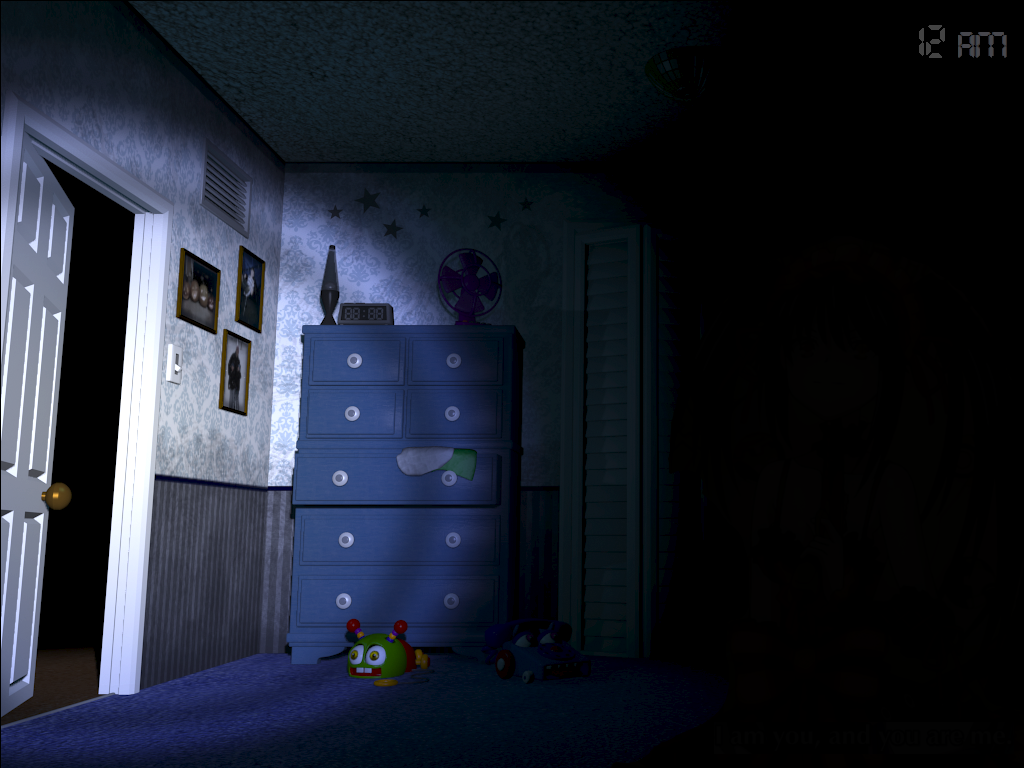
As previously mentioned, GiBi shows a few YouTube comments claiming that MatPat's claim that all hospital rooms come equipped with a digital alarm clock is wrong. My first problem, if I were to be really mean, which I am going to be because that is what those who oppose Dream Theory have been to Dream Theory, is that there is no proof whatsoever that these people either work at hospitals or have intimate knowledge of hospitals besides their claim that they do. In other words, they could simply be lying in an attempt to discredit Dream Theory. However, my actual problem is that neither the claim that all hospitals come equipped with digital alarms clock and the claim that they do not can be proven or disproven without physically going to every hospital in the entire world and checking if they do. Why? Because there are millions of hospitals across the world. Some are older and have older equipment, whereas others are newer and have newer equipment. Some can afford more equipment because of their bigger budgets, whereas others only have a limited amount of equipment due to budget restrains. To therefore claim that every single hospital is the exact same in every single country is beyond delusional because no hospital is the exact same as another, which, not to be too suspicious, is something someone working at a hospital should know. But the more important problem with this logic is to assume that regardless of whether hospitals do come quipped with a digital alarms clock, Scott would have been able to know which one was true. This is simply ridiculous. There is no reason to believe that Scott regularly visits the hospital, like going to Church on Sunday, and for him to therefore be intimately aware of how hospital rooms come equipped. All that matters is how Scott imagined what equipment hospital rooms come equipped with. If Scott imagined hospital rooms to come equipped with a digital alarms clock, then I see no reason to not accept that, in the context of the FNAF universe, hospital rooms come equipped with digital alarms clocks. I am not really sure why this point, in particular, has invited so much scepticism. Did the suggestion that all hospitals come equipped with digital alarms clock truly shatter everyone's suspension of disbelief in a series with a night guard who is fine working at a place where there are haunted animatronics trying to kill him each night? Really? That was the straw that broke the camel's back? But I digress, because this is completely besides the point.
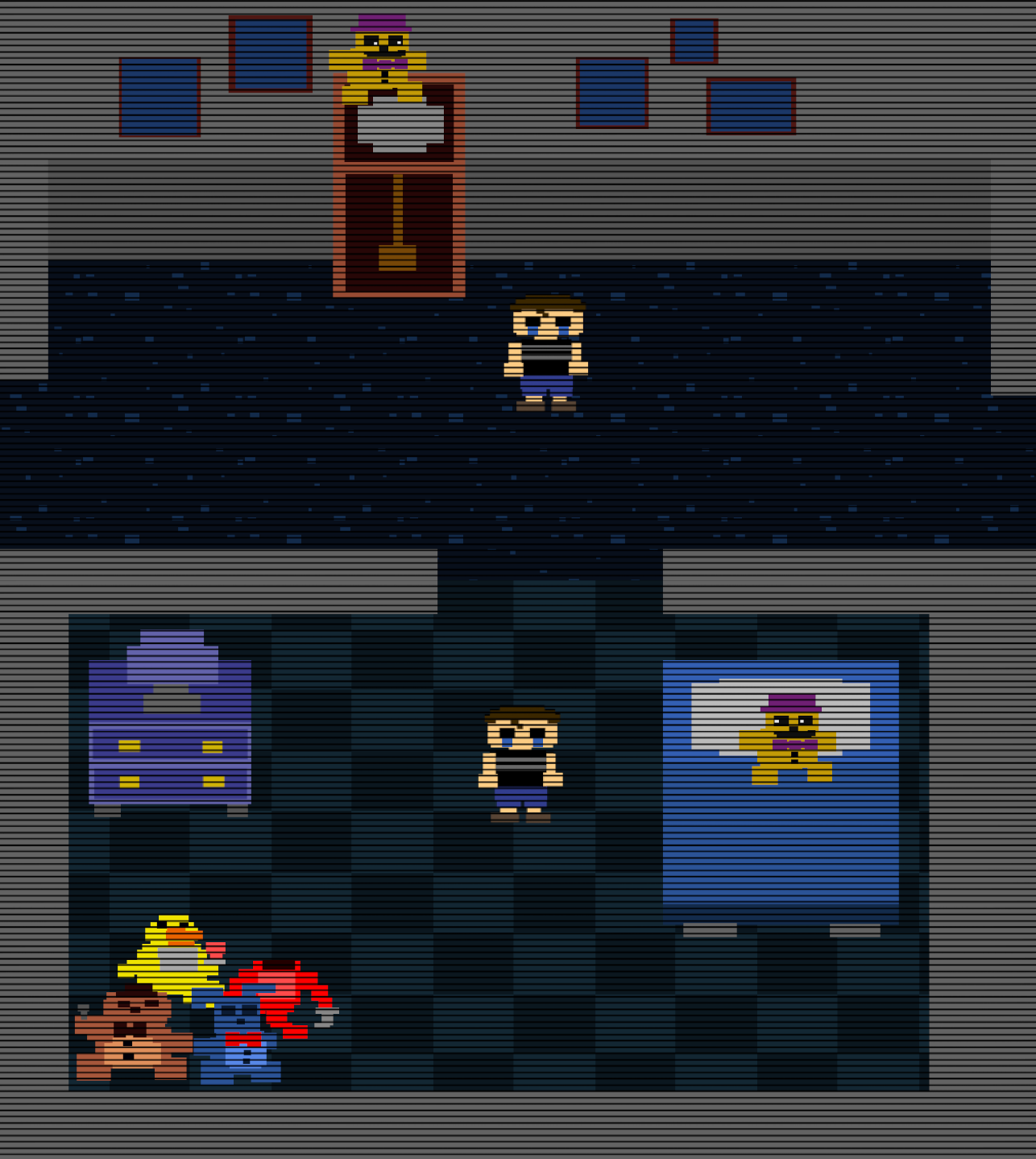
The point of using a digital alarm clock to signal the end of each night in FNAF 4, like MatPat explain but GiBi ignores, was because Scott did not want to reuse the same chime from his former games produced by a grandfather clock and therefore chose to use its complete antithesis, a digital alarm clock, to signal to the player that the place we were previously in during the previous games is not the place we are currently in. In other words, according to Dream Theory, we are no longer at home but are instead lying in the hospital. Because of this, we are no longer awakened by the sound of a grandfather clock chime at 6 AM, like in FNAF 1-3, but are instead awakened to the sound of a digital alarm clock, since we are no longer able to hear the chime of the grandfather clock. If Scott did not intend for this to be the case, why would he use a different sound, when there is a grandfather clock standing outside the Crying Child's room, as seen in the mini-game section? If the Crying Child is not in the hospital during the gameplay section of FNAF 4, why would the grandfather clock not chime at 6 AM, like it had done in the previous games? Why would there be another sound? But more on that later. The alarm clock is not necessarily meant to be taken literally (assuming, of course, that Scott did not think hospital rooms do, in fact, come equipped with digital alarm clocks). It is merely meant to be taken as a cultural shorthand, like how a room having white, brick walls typically signals it being a hospital or psych-ward. In this case, the clinical and almost hostile chirping of the digital alarm clock is meant to signify that the character we are playing as is no longer at home and is therefore unable to hear the warm and domestic chime of the grandfather clock right outside his room. Like how the player had been conditioned to associate the chime of a grandfather clock signalling the end of each night, the player had come to recognise this sound as something familiar and as an insurance of safety, because, once it chimes, the night is over, and the animatronics can no longer harm the player. As such, when the player, excepting to once again hear the chime of a grandfather clock after having not only been conditioned to except to hear one at the end of each night but also because they had seen one when flashing their light down the hallway, is instead greeted with a foreign sound, it no longer invokes the same associations of familiarity and safety, like the chime of the grandfather clock did. If this had simply not been obvious to GiBi, that would have been fine, but, at 9:04, he actually admits that the reason Scott used a flatline track to signal the Crying Child dying, despite this not being a thing (I have no idea if this is true, to be honest), is because it is not meant to be taken literally but instead symbolically.
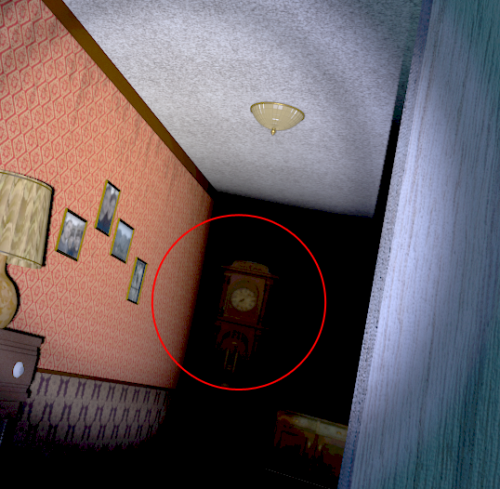
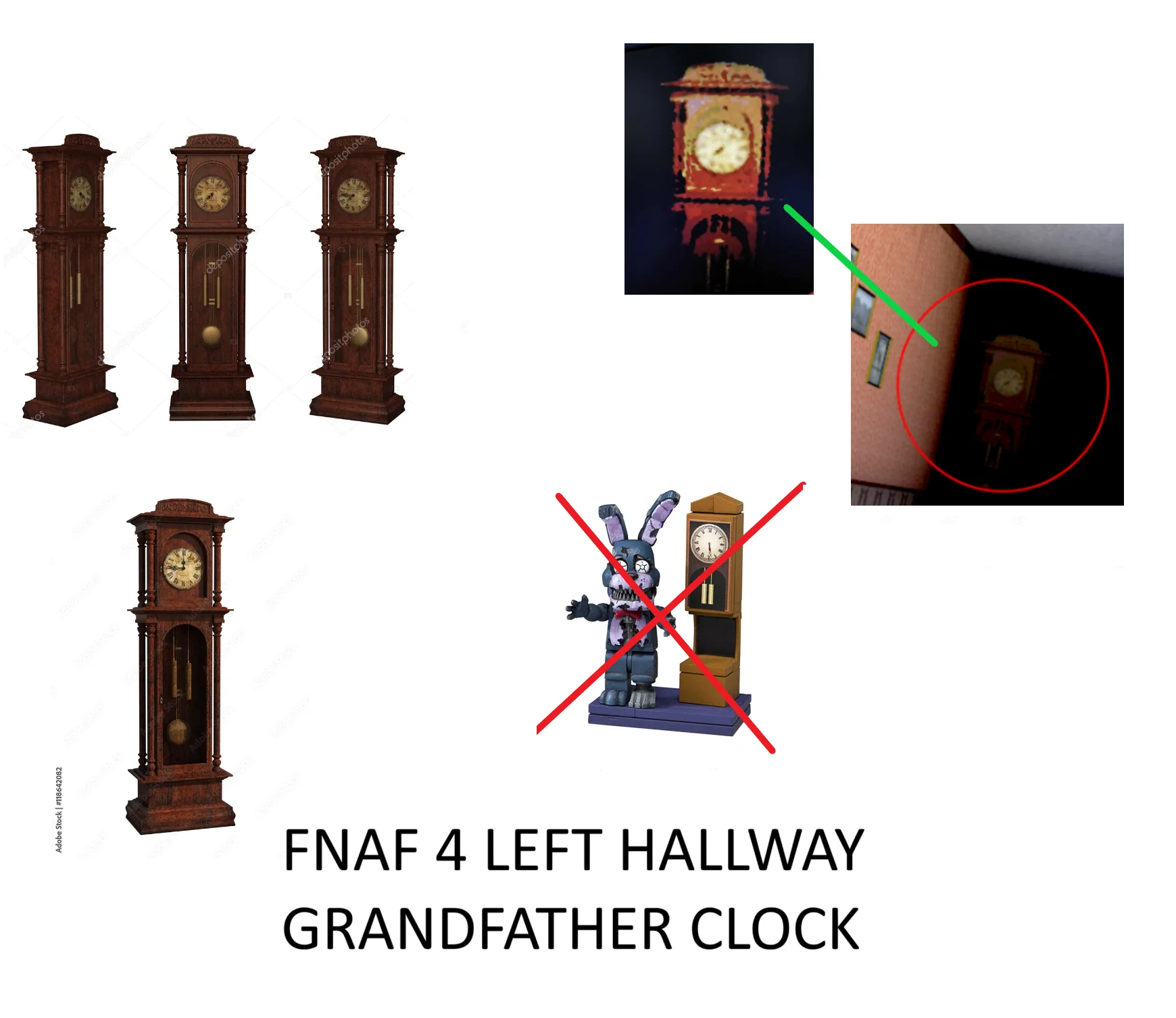
The problem with this video is not that GiBi's arguments are terrible. No, the problem with the video is that I cannot trust anything GiBi says because he proves himself to be a liar in his very own video, for absolutely no reason, by claiming, at 8:16, that the grandfather clock outside the Crying Child's bedroom, as seen in both the gameplay and mini-game section, is not a grandfather clock. Initially, I did not intend to dedicate an entire paragraph to this obvious lie, but, then, when I watched Nickolops video, I noticed that he also tried to claim that the grandfather clock shown in the game is not a grandfather clock, at 15:36. Not to mention that because no one in either of their comment section tried to correct them or accused them of being either blind or lying, I can only assume everyone who watched their video hated Dream Theory so much that they are willing to ignore reality if it means being able to discredit Dream Theory, which is insane, because that means I can no longer not only not trust anything GiBi says at face value but Nickolops, too, as they have, for no seemingly good reason, proven themselves to be intellectually dishonest liars. In any case, according to both, the grandfather clock outside the Crying Child's room is not a grandfather clock but is instead a wall-mounted clock, because we cannot see its fully body, in a pitch-black hallway, with a deliberately sharp contrast between what is lit up and what is not, when the grandfather clock is standing at the very end of the hallway, blending it in with the shadows. Of course, that makes perfect sense... Except for the fact that it does not. If, as they claim, that it is only possible to conclude what something is if it is fully lit up, with no shadows whatsoever, then there is nothing in FNAF they can use as arguments for anything, because everything in FNAF is covered in shadows or some sort of distortion. Even so, someone on Reddit found the exact asset Scott had used for the grandfather clock, which, to the surprise of absolutely no one with functioning eye-sight that is not an intellectually dishonest liar, revealed it to be a grandfather clock. However, even assuming it to be a wall-mounted clock, why would Scott purposefully include one if it had absolutely no bearing on the story, especially when considering there is clearly a grandfather clock down the hallway from the Crying Child's room, as shown in the mini-game section of FNAF 4?
Admittedly, there is indeed a digital alarm clock in plain view, standing on a drawer. With that being said, I think this is a red herring, for a number of reasons. First of all, if the clock chime has no significance to the overall story and is only meant to signal in the end of each night, why would Scott have not only changed it from a grandfather clock to a digital alarm clock but also place a grandfather clock down the hallway from the Crying Child's bedroom? No one, prior to FNAF 4, even batted an eye why a grandfather clock signalled in the end of each night in the previous three games, even when there was no grandfather clock in sight in any of those games, because everyone understood that all it was meant to do was to signal in the end of each night. If that was also all that the digital alarm clock in FNAF 4 was meant to do, why would Scott have bothered to change it? However, even assuming he simply wanted to change the grandfather clock to a digital alarm clock for no reason whatsoever, why would he, then, out of the few pieces of furniture and details in the game, decide to specifically place a grandfather clock outside the Crying Child's bedroom in both the gameplay and mini-game section, if he did not want us to think it was strange that the end of the night was now being signalled in by a digital alarm clock instead of the grandfather clock right outside the bedroom, like how it had been in all previous games? If this grandfather clock had no significance, it would not have been included in the game, but it was, which means that its inclusion does mean something. After all, in his post on Steam, Scott clarified that he did not fill the game with random Easter eggs.
The only theory to have ever been able to incorporate this detail as a meaningful detail rather than an insignificant Easter egg is Dream Theory. Under Dream Theory, the reason why each night in the previous games where signalled in by the chime of a grandfather clock instead of a digital alarm clock is because those games were the nightmares the Crying Child had of the animatronics before he got sent to the hospital, whereas FNAF 4 takes place during his time at the hospital, trying to recover from getting bitten, which is why each night is no longer signalled in by the chime of a grandfather clock, because he can no longer hear the chime of the grandfather clock standing in outside his bedroom since he is no longer at home and therefore hears the chirping of a digital alarm clock instead. On the other hand, under the theory GiBi and Nickolops believe that the older brother is the one experiencing the gameplay section of FNAF 4 as nightmares, there is no reason why Scott would have decided to include a grandfather clock in both the gameplay and mini-game section of FNAF 4. If there was no grandfather clock included in FNAF 4, and if each night in FNAF 4 was simply signalled in by the chirping of a digital alarm clock instead of the chime of a grandfather clock, like in the previous games, the reason for this change could very easily have been that each night is no longer signalled in by the chime of a grandfather clock and instead by the chirping of a digital alarm clock because the older brother is not at work but is instead at home, sleeping in his bed. It would have been nothing more than an insignificant Easter egg. However, it would have been impossible to argue that it would have been an unfair interpretation. The problem is the fact that there is a grandfather clock in both the gameplay and mini-game section of FNAF 4, which means that it must have significance, as it would otherwise be an insignificant Easter egg. Unfortunately for GiBi and Nickolops, under their theory, there is no reason why this grandfather clock exists, which is why both of them simply try to deny its existence.
Although MemoryVictim and LoopVictim have successfully accounted for the Easter eggs in FNAF 4, they fail to explain why there is a grandfather clock outside the Crying Child's bedroom. The problem with them is not necessarily that their reasoning does not makes sense. It makes sense that, according to MemoryVictim, the reason the end of each night in FNAF 1-3 is signalled in by the chime of a grandfather clock is because this was inspired of the Crying Child's memory of the grandfather clock outside his bedroom, and that, according to LoopVictim, that the reason a grandfather clock is present outside the Crying Child's bedroom is because the chime of a grandfather clock that signals in the end of each night has bled into past events. The problem is not that it does not make sense but simply that there is no reason for any of these two cases to occur besides that the reason for this being the case is because it needs to be so for the theory to make sense. The inclusion of a grandfather clock to explain why it is that each night in FNAF 1-3 are signalled in by the chime of a grandfather clock as opposed to the chirping of a digital alarm clock in FNAF 4 is only necessary to explain because Scott decided to make it so that each night in FNAF 4 was signalled in by the chirping of a digital alarm clock. If there was no reason for this change, but the existence of the grandfather clock was still necessary to include to explain this discrepancy, why would Scott have bothered with this at all if it had no significance? In other words, why bother solving a problem that was introduced in that very game and therefore the need to provide a solution to it, when there was no need to introduce the existence of that problem, in the first place?
At 5:05 and in this new video, he claims that FNAF 4 was never intended to be the last game, despite Scott having confirmed on numerous occasions that FNAF 4 was indeed supposed to have been the final game and that the only reason it was not was because of the backlash he received for it. For example, in this transcript of Scott's post on Steam to Reddit, Scott writes, "I had originally wanted FNaF 4 to be the end but wasn’t satisfied with what people took away from it." And in this update to FNAF 4 on Steam he wrote, "It's very important for me to say again that there will NOT be a Five Nights at Freddy's 5. The story is complete, and the Halloween update and new game will not add to it." Funnily enough, at 14:20 in his new video, GiBi actually references a post made by Scott that specifically states that FNAF World was going to be the last game and comments, "It is pretty black and white that he's saying that the series is going to end with FNAF World." In other words, he refutes not only this new video but his entire video on Dream Theory all by himself. Thank you, GiBi. Very cool.
At 5:45, he shows a clip from Dawko's first interview with Scott but fails to provide a timestamp (it is at 15:50). During the clip he shows, Scott is talking about how he, during the development of FNAF 2, had already picked out the general aesthetic and theme of the third, fourth, and fifth game. However, he mentions nothing about the lore. To therefore assume, like Gibi does, that Scott had the lore planned out for Sister Location is a massive overreach with no evidence to support it, because all that Scott is talking about are the general aesthetics. Scott even even states, at 16:55, that apart from having picked out the aesthetics, he had nothing else planned for them. As a writer myself, I have many ideas about future content. Some of it makes it into the final draft. Some does not. Sometimes I combine multiple essay into one. Other times I divide one essay into two. Sometimes I have an idea and it becomes an essay. Other times I discard of it. Scott could have had an idea about what type of game FNAF 5 could have been during the making of FNAF 2 but during the creation of FNAF 4 (and 3) decided to not materialise it, because he had already told the story he had wanted to tell. In other words, simply because you happen to have an idea does not mean you have to or even will turn that into a something. Any writer would be able to attest to this, even GiBi himself, who I am sure has had many ideas about possibles videos he could make, but who most likely has not turned every single idea of his into a video. Basically, just because Scott had a vague, general idea about the potential of a fifth game that is now known as Sister Location does not imply that his original intention for the story that Sister Location ended up telling was planned out when he was making FNAF 2 and never changed. As a matter of fact, to claim that Scott has never altered any of his games in response to criticism is denying reality. FNAF 4 trying incredibly hard to be scary was born out of Scott's desire to prove to the fanbase that he can make scary games, after the fanbase had criticised Springtrap's jumpscare in FNAF 3 for not being scary. And Sister Location having an incredibly overt storytelling instead of the usual cryptic way Scott had told his stories before was done in response to the fanbase thinking FNAF 4 was too cryptic. If Scott had planned out the games when he was making FNAF 2 and did not delineate from what he had planned out when making FNAF 2, none of these changes would have happened. It should also be mentioned that if, as GiBi believes, that Scott had the entire timeline planned out when he was making FNAF 2, why did Scott not mention FNAF 6? In case the reader was not aware, the story does not end at Sister Location. It ends at Pizzeria Simulator. As such, when GiBi later, at 6:26, concludes that because FNAF 5 was planned out all along, and because Sister Location refutes Dream Theory, that must mean that Dream Theory was never the original intent of FNAF 4, there is nothing to support this. FNAF would have ended at FNAF 3 if not for the backlash it received for not being scary, and FNAF 4 would have been the final chapter if not for the backlash to Dream Theory. In other words, nothing GiBi says could ever possibly mean that Sister Locaton did not retcon Dream Theory, because everything he says is a denial of reality.
From this point onwards, GiBi tries to use evidence from the later title to debunk that the original intention for FNAF 4 was Dream Theory, despite this, as I have already explained, being nothing short of an admittance that the only theory all the available evidence from FNAF 1-4 support is Dream Theory, and that the only way to explain the events of FNAF 4 with an alternative theory is by relying on evidence from later titles, after FNAF 4 had been retconned by Sister Location so that Sister Location could exist. In other words, he is trying to use evidence that was deliberately crafted to contradict Dream Theory to disprove Dream Theory. Great. Regardless of this, there are a few problems that I nevertheless want to address, even if there is absolutely no need for me to even remotely entertain anything past this point in the video, which should speak volume, because I am not even at the half-way point of it yet. Namely, I want to properly refute his claim at 9:15 that the character we control during the gameplay section of FNAF 4 is not the Crying Child but is instead the Crying Child's older brother. And, no, I will not even be referring to the older brother by his name given to him in Sister Location, because there is no evidence of that being his name in FNAF 4, nor is there any evidence to support the claim that he is the character we control during the gameplay section of FNAF 4. As a matter of fact, not only is there not even the faintest shred of evidence that the character we control during the gameplay section is the older brother, every detail present in the gameplay section directly refutes this claim to the point that the only possible way someone could ever consider this possibility be true is if they had simply never played FNAF 4.
Simply from the way the character we control during the gameplay section moves about the room, like how the camera (the perspective of the character) is eye level with door knob and how it takes him a considerable amount of time to run back and forth, from place to place, as a result of having short legs, it is ridiculously obvious that he is supposed to be short. In other words, it is very obvious that we are playing as the Crying Child and not the older brother, because the older brother is clearly taller than the Crying Child, as shown during the mini-game section of FNAF 4. For what reason would Scott decide to make the older brother noticeably taller than the Crying Child, whilst also making it incredibly obvious that whoever we control during the gameplay section of FNAF 4 is short, if not for the purpose of signalling that we are supposed to be playing as the Crying Child, not the older brother? If the character we are controlling is supposed to be the older brother, and if the older brother is supposed to be roughly twice as tall as the Crying Child but only half the height of a door, then that would mean that the Crying Child would have to be one quarter the height of a door tall, which would make him roughly stand at a whopping 50 cm, the height of a 1-year-old. This is obviously absurd, which is why it is not the case. Not to mention that it is shown, during the mini-game section, that the Crying Child is allowed to walk around unsupervised, and that the Crying Child is able to walk around, on his own, without trouble. Neither of which a 1-year-old would be allowed or even able to do. It is also not true that the Crying Child and his older brother are simply that much short than their contemporaries, because the Crying Child is the same height as all other children scattered across the mini-game section, and the older brother is the same height as his friends. In other words, they are the same, normal height as everyone else, who we can only assume are meant to be of average height, because there is no evidence to suggest anything else, and because them being of average height is the assumption that makes the most sense in the absence of evidence to the contrary, in a series without a track record of people being either extremely short or extremely tall. As such, it would be far more reasonable, from both a common sense perspective and contextual evidence found in FNAF 4, to assume that the Crying Child is the character we are playing as during the gameplay section of FNAF 4.
At 7:19, he mischaracterises Dream Theory and tries to frame it as being something that it is not. He claims that, according to Dream Theory, after the Crying Child is bitten, he is moved home instead of being directly taken to the hospital. It is here he dreams of FNAF 1-3. What Dream Theory actually proposes is that the Crying Child dreams of FNAF 1-3 before getting bitten, before getting sent to the hospital. This imaginary interlude between the bite and the hospital does not exist. It was simply something GiBi made up to make Dream Theory appear to be incorrect by appearing as too convoluted. But I digress. He, then, tries to claim that the gameplay section of FNAF 4 (which, according to Dream Theory, is a nightmare, as is evidenced by the fact that the animatronics are called the "nightmare animatronics") does not correspond to the physical layout of the house, as shown during the mini-game section of FNAF 4. This is not an incorrect observation, but is also does not contradict anything that Dream Theory claims. According to Dream Theory, the reason why the Crying Child's bedroom has a different layout during the gameplay section compared to the mini-game section is simply because it is a nightmare, which does not need to operate on the same logic as reality, nor does it need to correspond to what is true in "real life," which would be the mini-game section in the context of FNAF 4. In contrast, if this was supposed to be the older brother's bedroom, then why is there a grandfather clock down the hallway from the bedroom in the gameplay section, when the only bedroom in the house where opening the door and looking down the hallway would allow one to see a grandfather clock directly facing oneself is the Crying Child's bedroom, not the older brother's? Not to mention that the left hallway in the gameplay section, which is where the grandfather clock is located, features a lot of pictures hanging on the wall, in a disorganised manner, similarly to there hanging what appears to be a lot of pictures as well on the wall of hallway the grandfather clock is located in, in the real house in the mini-game section. Why would Scott decide to include these details in both the mini-game and gameplay section of the game, and for them to line up with each other, if he did not want us to deduce that the bedroom we find ourselves in during the gameplay section is supposed to belong to the Crying Child, and that we are supposed to be playing as the Crying Child during both sections of the game?
At 9:30, GiBi claims that the older brother is experiencing these nightmares sometime before the events of FNAF 3. There is no evidence for this, and, although GiBi does not claim it in this video, from what I could find, there is also no evidence to support the claim made by Nickolops in his video, at 32:46, that we play as the older brother experiencing nightmares about him being the Crying Child who, in turn, is being tormented by the animatronics he was afraid of, because of the guilt the older brother feels for having caused the Crying Child to have died in an accident, or that the Crying Child's soul is influencing the older brother's nightmares, like people have also tried to claim. What is actually funny is that, by admitting that the only way to explain how the older brother could possibly be the one we play as during the gameplay section by claiming that we play as the older brother dreaming about him being the Crying Child, the entire argument becomes nothing short of a tacit admission that nothing in the entire game even remotely hints at the possibility of us playing as the older brother during the gameplay section. Admittedly, it could still work, at least in theory, if there was any evidence to support this level of absurdity. But there is none. All the evidence for this is borrowed from later titles, which means that the entire theory is nothing more than a ad-hoc explanation for how it could even remotely be possible for the older brother to have been the one experiencing these nightmares all along based on said later evidence. In contrast, there is evidence for the Crying Child to have been the one experiencing these nightmares: throughout the mini-games of FNAF 4, the Crying Child is both depicted and explicitly stated to be terrified of the animatronics, which is why he is having nightmares about him being tormented by terrifying versions of the animatronics that would only have been possible to conceive of if one was terrified of the animatronics.
In any case, using only evidence from FNAF 4, if the older brother is the character we control during the gameplay section, like it should be possible to prove if he had indeed been intended to have been the character we play as during the gameplay section, why is he fending off the nightmare animatronics? Is it because he is afraid of them to the point of having nightmares about them? No, because it is never shown throughout the game that he is afraid of the animatronics. As a matter of fact, he is shown to be actively bullying the Crying Child for being afraid of the animatronics, which would suggest that he finds the Crying Child's fear of the animatronics to be unfounded. If the older brother was also afraid of the animatronics, why would he bully the Crying Child for being afraid of the animatronics? Would he not express sympathy for his fears instead? As such, if it is not a nightmare, then the gameplay section could only be real... right? No, of course not. Why would the owners of Fazbear Entertainment, who make animatronics for the purpose of making their establishment seem more friendly to children, decide to make animatronics that serve the explicit opposite purpose of that? And, no, there is no evidence for the claim that these animatronics were built to kill or capture children, because the statement, "What is seen in shadows is easily misunderstood in the mind of a child," implies that there have been no murders, and that whatever it was that the Crying Child think he saw to make him scared of the animatronics was simply a misunderstanding. As such, it would make for more sense for the character we play as to be the Crying Child having nightmares about being attacked by the animatronics he fears in his own home, since he is afraid of them and also because he does not feel safe at home, because of his older brother's constant torment. That is, after all, the very reason the Nightmare animatronics lift our character up into the air when we get jumpscared, because the way the Crying Child was sent to the hospital was by getting lifted up into the air by his bullies, stuffed into the mouth of Fredbear, and, then, bitten, splattering blood across the entire screen instead of getting greeted by static, like in the previous games.
I wanted to use this as an excuse to refute any lingering counter-arguments. At 18:06, GiBi makes the claim that because Scott included a reference to Dream Theory in UCN and presented it as a joke, alongside other commonly known crack-pot theories, that it must mean that Dream Theory was never true. Ignoring the fact that GiBi has yet to present a single argument that hold even a droplet of water, this could simply have been Scott wanting to distance himself from it by trying to portray it like it was never true, or it could simply have been self-deprecating humour. Or do people actually believe that when Scott replied, "I know right? Who came up with this anyway?," to someone on Reddit asking who came up with Dream Theory, he was not taking a piss at himself? I may be autistic, but even I can tell as much. Then, at 13:35, GiBi claims that Dream Theory is not true because a child would not be aware of the exact changes in minimum wage, years after his death, which is a fair point. However, this ignores the fact that Dream Theory was not the original story of the FNAF trilogy. Before FNAF 4, when only FNAF 1-3 existed, there was nothing to support Dream Theory being true. But when FNAF 4 was created as an attempt to compensate for the lacklustre horror in FNAF 3, there was suddenly evidence to support it. In other words, just like how Sister Location retconned FNAF 4, so, too, did FNAF 4 retcon FNAF 1-3. Likewise, just like how many Easter eggs in FNAF 4 can only be explained under a Dream Theory paradigm but make no sense after the release of Sister Location, so, too, will details, like the pay-check and phone-calls, simply not make sense, because Scott retconned them. In any case, there is no reason for me to further engage with this video, because he is not even engaging with the actual contents of FNAF 4. All he does is use evidence from later games, when FNAF 4 had been retconned, to disprove it. My favourite part of the video is when he, at 13:49, claims that the statements Scott made to try to guide the fanbase unto the right track do not actually need to have an answer... are you even hearing yourself talk? Because that is how everything stated in this video makes me think, like there was no thought behind anything.
Returning to Nickolops's video, at 30:43, he makes the claim that his entire thesis essentially hinges on the phone call heard in the background during the gameplay section of FNAF 4 (because it is the only trace of evidence that could even remotely prove that the one we play as during the gameplay section is the older brother, which means that refuting it means refuting that entire line of thought). There are more details than this explored in the video, but I have already indirectly refuted all of those, and now I am going to refute this one as well. As Nickolops explains, the phone call heard in the background is the game phone call that plays during the first night in FNAF 1. Although heavily distorted, it is undoubtedly the same phone call. According to Nickolops, if, as I, too, agree with, FNAF 4 takes place in 1983, how, then, is it possible for the Crying Child, who dies that same year, to hear a phone call referencing the bite of '87, an incident that takes place 4 years after his death? From this, Nickolops concludes that because it would be impossible for the Crying Child to hear this phone call, it would be impossible for him to be the character we control during the gameplay section, means that the character we control must be the older brother. The only problem with his conclusion is, as I have already explained, we are clearly not playing as the older brother, which means that there is a problem with this argument, since his conclusion is unsubstantiated by the game.
The problem with his train of logic is not that it is illogical. It does make sense (even if the conclusion is nonsensical), if FNAF 4 was always supposed to take place in 1983 and not 1987. In the the reader was not aware, in most of the teasers leading up to the release of FNAF 4, the new Nightmare animatronics were featured along with the caption, "Was it me?," and because references to "87" were scattered across the html code for the website where these teasers were being hosted, it led many to suspect that what was being asked in these teasers was whether that animatronic was the one responsible for the bite of '87, which would have made sense for Scott to make a game about to address, since it was the only remaining question that had yet to be fully answered. Then, once the game released, DJ Sterf, in this video, at , makes the discovery that all of the bullies (the ones responsible for the bite) have "87" in their hex code. Out of them, the one whose hex code is nothing but references to "87," is the older brother's, "787878," which, in combination with "87" appearing in Foxy's eye in one of the teasers would suggest Foxy was responsible for the bite of '87. Needless to say, for a game about the bite of '83, there sure are a lot of references to the bite of '87, would the reader not agree? I believe that the reason all these references exist in both the teasers and the game is because FNAF 4 was originally meant to take place in 1987 but was changed to 1983 last minute, for reasons I will discuss soon. Otherwise, their inclusion would simply not make sense.
It should be noted that what I mean by this is not that FNAF 4 was supposed to depict the actual bite of '87, as we hear about in FNAF 1 and 2, and that Dream Theory was a last minute change Scott made, or that Foxy was originally going to be the one responsible for the bite, as the teasers would have us believe, and that Fredbear being the one who was actually responsible for the bite was a last minute change. No, what I mean by this is not that Scott rewrote the entire story of FNAF 4 and created all mini-games two mere days before releasing the game but simply that he decided to change the date of the bite we witness in FNAF 4 from 1987 to 1983. Everything in the entire game, except for this date, would have been the same. Fredbear, for example, being the one responsible for the big bite instead of Foxy had already been established with, "Probably me," appearing in Nightmare Fredbear's stomach, in response to the implied question in the teasers of, "who did the bite of '87?" Foxy having "87" in one of his eyes might therefore have been meant to imply that Foxy instead bore witness to the bite of '87 happen rather than Foxy having been the one who bit someone, whilst, at the same time, imply that Foxy might have had something to do with the bite. In other words, what the big bite in FNAF 4 was meant to answer was not what happened during the bite of '87 in FNAF 2, originally, before the story of those previous three games got retconned by Dream Theory in FNAF 4, but rather answer what event in the real world was it that inspired that event to be referenced in the Crying Child's nightmares, like how the reason a grandfather clock appears in the left way hallway in his nightmares is because there is a grandfather clock in the hallway of his home in the real world. Basically, what the big bite in FNAF 4 was meant to be was what came to inspire the bite of '87 in the Crying Child's own nightmares from when he himself got bitten in '87, before Scott changed it to 1983.
Although it may seem as if this would have been impossible, as it would have simply taken too much time for Scott to have been able to completely alter a game that was originally supposed to take place in 1987 into a game that instead takes place in 1983, especially when considering the fact that the hidden references to "83" in the html for Scott's website only started to appear 2 mere days before its release, the fact of the matter is that it is very obvious that Scott made no attempt to remove any references to 1987. After all, the older brother and his friends all still have "87" in their hex codes. In other words, the reason Scott was able to convert a game that was originally meant to take place in 1987 into a game that instead takes place in 1983 in such a short amount of time was because he did not even attempt to convert it but instead opted for explicitly giving us the answer. This is why the only reference to 1983 in the entire game is a brief TV segment, which looks like it was made in less than 5 minutes, and, correct me if I am wrong, but the last time I checked, 2 days is a lot longer than 5 minutes. As such, I think it is safe to say that Scott, judging from what clues there are in the game hinting towards FNAF 4 taking place in 1983, would have been able to make this last minute change.
This is also why the evidence for why FNAF 4 takes place in 1983 is so unique compared to the previous three games. In FNAF 1 and 2, we figured out the date by comparing the minimum wage of each year to the amount we earned by the end of the week. And we have yet to really figure out what year FNAF 3 takes place in, other than that it takes place 30 years after Freddy Fazbear's Pizza closed its doors. But, then, FNAF 4 comes out and, after having been extensively teased to take place in 1987, is explicitly revealed to have instead taken place in 1983 by something that looks as if it was made in less than 5 minutes. Needless to say, compared to the previous three games, the way that it is revealed what year FNAF 4 takes place in is different from the rest, because instead of leaving breadcrumbs for us to find, so as to allow us to figure out the answer on our own, Scott decided to instead give us an explicit answer. I find that this different approach, which is unique to only FNAF 4, is particularly telling that this was indeed a last minute change, as the only reason Scott would have had been forced to explicitly spell out the exact date FNAF 4 takes place in to us, instead of leaving breadcrumbs for us to figure out, was if the breadcrumbs he had left hinted towards another date than the one he had finally settled on.
But why did Scott decide to change the date from 1987 to 1983? I am not entirely certain, but I do have my suspicions: I think he did it because it would break the lore even further than if FNAF 4 took place in 1987. As we all know from that Markiplier clip, it does indeed make no sense for the bite in FNAF 4 to be the bite of '87 (because it was not caused by an animatronic being able to move about, making the choice to render the animatronics unable to move during the day, as a result of the bite of '87, as explained by Phone Guy in FNAF 1, a very strange decision if that change was not meant to prevent another bite from occurring). As such, making that bite another bite, the bite of '83, made the timeline make sense. However, even if the timeline did make sense in regards to the bite, what now made no sense was everything else in the game apart from the bite. For example, if FNAF 4 takes place in 1983, then why are there action figurines depicting the Toy animatronics before they were built in 1987 (Phone Guy refers to them as "new" in FNAF 2, which implies that they were very recently built)? The answer given to us is simply that the Toy animatronics were based on these figurines, which would have sufficed as an answer if Scott had not directly called their existence into question by asking, "In the FNaF4 minigame, why would the tiny toy chica be missing her beak?" If the inclusion of these figurines was merely meant to be an insignificant lore clarification, with little to no bearing on the overall story of FNAF 4, then why would Scott have drawn attention to them, in the first place, if their existence was not meant to help the fanbase solve the lore of FNAF 4? Because he wanted us to consider that the reason none of the Easter eggs in FNAF 4 made any sense was precisely because they were meant to make no sense under the timeline paradigm (the one we had up until then assumed to be true) and for them to instead only make sense under a new paradigm, Dream Theory.
It is for these reasons he did not want us to speculate about what year FNAF 4 took place in but wanted it to instead be set in stone so that there could be no room for doubting the lore breaking implications of these Easter eggs. If Scott had not been as explicit as he had been, the common consensus would most likely have been that FNAF 4 took place in 1987 and that the bite depicted the bite of '87, since that is what all the teasers had been hinting towards, after all, even if that did not make any sense, simply because it would have at the very least made far more sense than if it took place in 1983. Because if a tiny Toy Chica figurine could exist in 1983, 4 years before its animatronic counterpart was produced, then that must mean that the design of the Toy animatronic was based on that figurine. And although that does suffice as an answer, the problem, as already explained, is that this answer does not suffice as an answer simply because of the fact that Scott, after having stated that no one had solved the lore of FNAF 4, decided to, in an attempt to help us solve the lore as he realised we would simply be unable to do so on our own without some assistance from him, ask the simple question, "In the FNaF4 minigame, why would the tiny toy chica be missing her beak?," because the actual question is not necessarily why the tiny Toy Chica would be missing its beak but rather why the answer to that question would be relevant enough to the lore of FNAF 4 for Scott to think that that answer would have helped us to solve FNAF 4. Obviously, because the answer that the reason why the tiny Toy Chica is missing its beak is because it is meant to imply that the Toy animatronics were based on these action figurines does not help solve the lore of FNAF 4 outside of being an inconsequential lore clarification, it could not have been the answer Scott was hoping for, since the answer Scott was looking for was, like with his third statement about, "Four Games. One Story.," for us to re-examine the story from another perspective, from another paradigm, in-order for us to consider Dream Theory.
If FNAF 4 was not originally meant to take place in 1987, only for Scott to later change it to 1983 last minute, why is it that, before he would finally settle on 1983, he released two teasers that mention 1982, a date that is never mentioned anywhere in the entire game? If FNAF 4 was always meant to take place in 1983 and the 1987 references are merely red herrings or something of the like, then why was 1982, a date not found in the game or the entire franchise at that point, mentioned in two of the later teasers, after Scott had already released all the 1987 teasers? Obviously, because there are no references to 1982 in the entire game, it would seem as if Scott had first decided to change the date from 1987 to 1982 but later settled on 1983, for unknown reasons. After all, this is not the first time something shown in a teaser or trailer to a FNAF game did not make it into the final product. For example, in the trailer for FNAF 1, Bonnie is shown to both run down the hallway, like Foxy ended up doing, and remove his face before, presumably, jumpscaring the player (or maybe that was the jumpscare?), which Bonnie does not do in FNAF 1.
It is for these reasons I believe the distorted FNAF 1 phone call heard during the gameplay section is merely a remnant from when FNAF 4 was supposed to be about the bite of '87, like how the older brother and his friends all still have "87" in their hex codes, suggesting that they were the ones responsible for the bite of '87. However, it could also have no significance at all. After all, Nickolops mentions how it is possible to hear a dog barking in the background as well. Obviously, if we were to assume that this phone call has any significance simply because Scott said that there were no random Easter eggs in the game (more on that in a moment), then we must also assume that a dog barking in the distance must also have significance. So, does Nickolops ever explain what the meaning behind this dog barking is? No. As such, considering that the dog barking has no relevance to the lore, the most likely case is that this phone call also has no relevance. In all likelihood, it was most likely a case of Scott deciding to reuse an asset, which would explain why he decided to distort it, in the first place, so that people would not be able to recognise it. Assuming this to have been the case, it would also explain why Scott decided to choose this particular phone call out of all phone calls. If the reader were Scott, and he wanted to reuse a phone call, what would be the first track to come to mind? The one for night 3 in FNAF 2? Or the very first phone call in the entire series, the one for night 1 in FNAF 1, the one Scott chose to use as background noise, like how we can hear a dog barking?
The fundamental problem with this entire video, essentially, is the assumption that Nickolops makes about this phone call being one of the non random Easter eggs Scott was referring to when he made his Halloween update about FNAF 4, when that seems to be very unlikely. The reason Scott decided to make this clarification was not because people were confused about whether any of the ambience, like this elusive phone call, in FNAF 4 had any significance to the overall lore or if they were simply random Easter eggs. No, the reason he decided to make this clarification was because people were confused about whether the Easter eggs in the mini-game section had any relevance to the overall lore or if they were simply random Easter eggs to the previous games. And because they were not random Easter eggs but instead did contain vital information for solving the lore of FNAF 4, Scott decided to clarify that they were not random Easter eggs. By assuming that this phone call has any significance to the lore whatsoever, it ends up becoming the only relevant piece of information in FNAF 4 that is used to solve FNAF 4, as it is the only evidence Nickolops's uses to prove his theory, whilst ignoring the rest of the game, in its entirely, which refutes his entire video, because, in-order for the so-called non "random Easter eggs" to not be random and to therefore have significance, all of them have to be relevant to solving the lore, not simply one.
If this were not the case, if the phone call was neither merely some background noise or a remnant from when the game was supposed to take place in 1987, and that it was instead supposed to be the clue that solves FNAF 4, as Nickolops claims it is, then why did Scott not mention anything about it during the livestream? Assuming Scott wanted to help them solve the lore of FNAF 4, and assuming that the older brother was supposed to have originally been the one we play as during the gameplay section of FNAF 4 as well as the one we play as during the previous three games, why did Scott not provide anything hinting towards this? If this was what Scott had wanted us to figure out all those years ago, why did he not even try to make us think along those lines once he decided to intervene? Why did he decide to, assuming this was the original intention, make three statements about things that Nickolops admit all amount to nothing, if Scott had wanted to help us solve the lore of FNAF 4? And when someone in chat who went under the alias of "Scott Cawthon" asked if they had thought of who the night guard was, at 1:27:26, why did Scott, at 1:32:56, decide to email Dawko and clarify that anyone claiming to be him in chat was an impostor? If the original intention was for the older brother to have been the night guard, would it not have made more sense for Scott to have instead said something along the lines of, "Anyone commenting in chat is fake. With that said, have you thought about who the night guard is?," instead of merely debunking its validity? Clearly, he did not want them to go astray trying to figure out who the night guard was, because that was not what Scott wanted them to do. In other words, the older brother cannot have been the one experiencing these nightmares nor can he have been the one we play as in the previous three games, because that would mean that the identify of the night guard was important, which seems to have not been the case, as Scott explicitly went out of his way to confirm that was not the case.
In the beginning of this section, I explained why I liked Dream Theory: because it had emotional weight. The older brother being the one experiencing these nightmares has no emotional weight, which is why I utterly despise it, and was the reason why I decided to refute all attempts of debunking Dream Theory, in the first place. Having him be the protagonist of a story he is merely a side character in (or, if the reader wanted to inflate his overall importance by imposing such a title on him, the villain) is genuinely terrible writing, which is, once again, why I am glad Dream Theory was the original intention... until Scott decided to ruin it by making the older brother the protagonist. Great. It would be like if Alice, in Alice in the Wonderland, was not the one who dreamt that she herself fell down the rabbit hole but that it was instead her teacher, who has the collective screen time of a few minutes and next to no importance to the story, who dreamt of Alice falling asleep and dreaming of falling down the rabbit hole. By introducing another layer, it makes both Alice's and the Crying Child's experiences come across as insignificant and strips the story of its emotional weight, which cheapens the story, because it makes their story not theirs but someone else's instead, because it was never they who was the one who was actually dreaming. They were merely a character in the actual protagonist's dream.
And, with that, I believe I have now fulfilled the second condition of refuting every single worthwhile theory to engage with and can therefore confidently conclude that the only theory left standing is Dream Theory.
...What do you think, everyone?
As has been referenced previously, Scott explained in his interview with Dawko that FNAF 4 was too broad for interpretation. In my sub-section about the three statements, I explained that what I think Scott meant by this was that base FNAF 4 was too broad for interpretation, because it alone was not enough for the fanbase to make the connection that all previous games had been the nightmares of the Crying Child, not only the gameplay section of FNAF 4. To combat this, Scott made his three statements, which strongly hinted towards the previous three games having been nightmares, that the animatronics were not haunted, and that no murders had occurred. However, I do not think this is the full scope of what Scott wanted to accomplish with FNAF 4. In short, I do not think Dream Theory, as presented by MatPat in his video on Dream Theory, was able to answer all questions posed in FNAF 4. For example, MatPat had no answer for what the Crying Child's Fredbear plushie was supposed to be and instead simply resorted to jokingly calling him "psychic friend Fredbear." In other words, he simply ignored the Fredbear plushie. I believe that FNAF World was an attempt to answer the still unresolved question of what the Fredbear plushie was supposed to be by Scott after having seen that not even MatPat was able to answer this question. Unfortunately, despite the fact that MatPat did indeed play FNAF World, he never made a video about it, trying to solve it. If the first part of this section was meant to be a defence of Dream Theory, then this last part of it will be an attempt to answer all remaining questions about FNAF 4, from the perspective of Dream Theory.
Some have argued that the reason the Crying Child's sister's room is empty is because she is dead and that her soul came to possess the Fredbear plushie, which is why it seems to have a will of its own, and why it would want to help the Crying Child. I do not agree with this theory simply because there is no evidence to support it. First of all, there is no reason to believe that the Crying Child's sister is dead simply because her room happens to be empty. All that means is that she is not at home, which does seem to be the case, since it seems fairly obvious that the girl playing outside their house, outside the empty girl's room, is supposed to be the Crying Child's sister, as both the toys she is playing with outside and the toy left inside in her bedroom are broken (a trait no other character shares), which would naturally suggest that they share the same owner, an owner who does not care if her toys are broken, as can be inferred from her dialogue, "Why are you crying? Don't you like my toy collection?," since she does not mention anything about her toys being broken, or that she is sad that they are broken, but seems to instead suggest that she is quite proud of them, despite the fact that her tiny Toy Chica figurine is missing its beak. In contrast, the problem with every other theory as to why the Crying Child's sister's room happens to be empty is that there is nothing to support any of the claims made since it is nothing more than baseless speculation inferred from her absence, like her being dead because she happens to not be home at the time, in the 1980s, when most kids played outside all the long, like we see a lot of kids do in the mini-game section and like how the girl with the Toy figurine collection does as well.
However, the bigger problem with this theory are its implications, because if we were to accept that the reason the Crying Child is afraid of the animatronics is because he witnessed his own sister getting stuffed into an animatronic suit, it would directly contradict Scott's second statement that clearly implies, as previously explained, that the reason the Crying Child is so terrified of the animatronics is because he misinterpreted something that he saw in the dark, as hinted towards, during the mini-game before the third night, by the Fredbear plushie exclaiming, "NO! Don't you remember what you saw? The exit is the other way! Hurry and leave.," when going the wrong way. In all likelihood, what the Crying Child saw was someone getting stuffed into an animatronic suit or, to be more precise, a Fredbear animatronic suit, which is why Fredbear, as opposed to every other Nightmare animatronic, has a mouth on its stomach, since, from the perspective of the Crying Child, it probably looked like the animatronic suit was being fed someone down into its stomach. This is why, during the same mini-game, when one instead goes right, attempting to leave Fredbear's as per the Fredbear plushie's suggestion, and is blocked from existing the building by an employee in a Fredbear suit (or simply "Fredbear" himself, from the Crying Child's perspective), the Fredbear plushie says, "It's too late. Hurry the other way and find someone who will help! You know what will happen if he catches you!" If the player, then, goes left, entering a different room, only to, then, return to where he previously came from, he will, then, witness the previously closed red door being opened and see the Purple Guy helping an employee put on his suit in a dark, staff-only room. In other words, by turning back and "getting caught" by Fredbear, it is possible to witness what it is that the Crying Child believes would have happened to him if Fredbear had caught him: getting stuffed into an animatronic suit. This interpretation is further hinted towards, during the mini-game before the fifth night, when the Crying Child is locked in the parts and service room and is completely distraught, pleading someone to let him out of there. Considering that the only two times the Crying Child says anything in these mini-games is during this particular one and during the one when he gets bitten, not to mention that this is the only time the Crying Child yells, in all caps, it is safe to assume that something about the room he is currently in terrifies him more than anything else. In other words, something about this room is most probably the source of his fear of the animatronics, which would seem to be that there is something that looks like hair sticking out of an empty animatronic suit, as if a corpse had been stuffed inside of it. But to return to my original point, as is very rare, this theory was actually officially debunked by Scott himself, unlike Dream Theory, because, in-order for it to be true, in the first place, the Crying Child could not have misinterpreted this event and would have had to instead correctly interpret seeing his sister get stuffed into an animatronic suit.
Another problem with this theory is that the real world, as shown in the mini-game section of FNAF 4, is very clearly supposed to not have any supernatural phenomena, like hauntings or possessions (which this theory requires to be true), since every time something along those lines is implied to exist, it is very obvious that whatever is being referenced is supposed to be interpreted as not being real, and that everything that would seem to be supernatural was instead created in the mind of the Crying Child from his fear of the animatronics. For example, the rumour that the girl with pigtails is spreading about the animatronics being haunted by the souls of dead children stuffed inside of them is simply that: a baseless, playground rumour that she herself probably came up with to scare people with, because the only time we actually see this being alluded to is when the Purple Guy is simply helping an employee put on his suit, which, as I have already explained numerous times by now, implies, based on Scott's second statement, that that rumour is not true. This is why her last line is, "Why do you look so worried? See you at the party! Ha ha ha!," because it is meant to imply that she does not even belief the rumour she is spreading herself, that she is only spreading it to scare people, and that we should not take the rumour at prima facie but to instead try to understand how the Crying Child would come to interpret this rumour, given that he is already afraid of the animatronics and believes himself to have witnessed something like this already.
Although there is no evidence to support the theory that the Fredbear plushie is possessed, it does remain a fact that the Fredbear plushie are white dots on black, which is believed to be an indication of an animatronic being possessed. The problem with assuming that this means that the Fredbear plushie is possessed is that, in-order for this to be true, there has to be some evidence to support it. But there is none, as I have very clearly demonstrated. More than likely, what Scott intended for these eyes to signify was simply that the Fredbear plushie possess a will of its own, separate from the Crying Child, despite being a product of his mind (more on that in a moment). One could say that Scott retconned, within the context of FNAF 4, the meaning behind these eyes to instead signify whether something possesses a will of its on rather than being used to signify whether an animatronic is possessed or not. It should also be noted that the Fredbear plushie sold by Sanshee, which is often times cited as proof of the Fredbear plushie indeed being possessed, since it advertises the Fredbear plushie as the "Possessed Fredbear Plush," is not proof of what the original intention for the Fredbear plushie to have been, since this item, along with a few other plushies, were first announced on February 21th, 2016, after the release of the first version of FNAF World on January 21st, 2016, which I think should be regarded as the cut-off date for when Scott decided to retcon Dream Theory, since every game released before then supports Dream Theory, whereas everything released after does not, which means that this piece of merchandise does not qualify as evidence.
There are also some that argue that the sister is not the girl playing with the Toy figurines but is instead the girl with pigtails, spreading rumours about the animatronics being haunted, because, as DJSterf uncovers in his video, the colour of her dialogue is the same as the colour of the dialogue the Fredbear speaks in during the Crying Child's final moments in the hospital, when one would expect to be surrounded by family and loved ones, not strangers or acquaintances. There are two problems with this argument. Firstly, when talking to her it is implied by, "See you at the party!," that the next time the pigtailed girl will most likely see the Crying Child is at his birthday party, which would not make much sense if they lived in the same house, where they would see each other every day. Secondly, it presupposes that Scott is very deliberate with his choice of colour and only uses certain colours for certain characters, which is simply not true. For example, in FNAF 2, when the Purple Guy is first introduced, Scott decided, for whatever unbeknownst reason, to represent him with two different sprites with different colour and shape instead of simply representation him with one single sprite. Then, in FNAF 3, he gave him a different sprite again with a different colour and a different shape from the other two previous sprites. And, then, he did the same thing in FNAF 4 once again. Needless to say, I do not think it is safe to assume that Scott has a history of being consistent. If anything, he has a history of being inconsistent with his designs. Although, if we were to assume that the Purple Guy present in FNAF 4 was supposed to be the final version of the Purple Guy, and that it was in FNAF 4 Scott decided to be deliberate with his sprite work once and for all in-order to signal this change in the speaker, why is it, then, that the girl holding a Spring Bonnie plushie and the kid sitting on the sidewalk, laughing, have the exact same hex codes for their respective dialogue, if the colour of all characters was supposed to have been unique to them and them only? Because Scott was, once again, not being consistent. In any case, my guess for why the colour of the Fredbear plushie's dialogue is different is simply because Scott made a mistake, and because it was so unimportant to the lore, he never really noticed it or cared to correct it, because it never meant anything.
When I re-watched MatMat's video on Dream Theory for the first time in a decade (fuck me), one thing, in particular, struck my interest: if, as Dream Theory suggests, that all animatronics are supposed to have been inspired by something the Crying Child would have witnessed in the mini-game section of FNAF 4, where is the inspiration for the Puppet? In MatPat's second video on FNAF 4, where he provides a literalist interpretation of FNAF 4 (which, in case the reader is wondering, fails to account for many Easter eggs, which is why both it and the alternative explanation he made for FNAF 4 after having made Dream Theory can be safely disregarded), he argues that, at 4:43, because both the Crying Child and the Puppet share the same design, since they both wear white stripes (or, in the case of the Crying Child, grey) on black, the Crying Child came to possess the Puppet after dying. Obviously, I do not agree with his conclusion. However, I do agree that the Crying Child himself was supposed to be the inspiration for the Puppet. More specifically, I believe that the Puppet is supposed to represent how the Crying Child is able to give life to the animatronics in his nightmares through his fear of the animatronics.
Some have argued that the Puppet, the Fredbear plushie, and any other kind of figure or force trying to put the Crying Child back together is supposed to represent the Crying Child's sister. In case it was not already obvious, because the sister cannot possess the Fredbear plushie or anything, for that matter, she can also not possess the Puppet or represent any other kind of figure or force trying to put the Crying Child back together. But, more importantly, there is no evidence to support the theory that the Puppet is possessed by the soul of the Crying Child's dead sister, or that she was the one who promised the Crying Child to put him back together. Even assuming this to be the case, if the Puppet is supposed to be a sort of helping hand, giving the souls of the dead children a chance to get their revenge on the Purple Guy for murdering them, like it was believed to have been the case during the original trilogy and is still believed to be the case after FNAF 4, why would the Puppet give life to the animatronics? If the Puppet is possessed by the soul of the Crying Child's dead sister, and she knows that the Crying Child is afraid of the animatronics, why would she, in his own nightmares, be the one who gives him a reason to be scared of the animatronics in his sleep by bringing them to life, when she is supposed to be helping him, not tormenting him, like everyone else? The answer is that it does not make sense, which is why the Puppet is not possessed by the soul of the Crying Child's dead sister, because she is not even dead, in the first place.
I think the underlying confusion stems from the belief that because the Puppet could be interpreted as trying to help the souls of the dead children in the originally trilogy, it must mean that the Puppet is also a force for good in FNAF 4. However, as should be obvious, this is not the case. The Puppet is not a force for good in FNAF 4, because there is no evidence to support that that reading has remained true. The Puppet is simply supposed to represent how the Crying Child's fear of the animatronics is what brings them to life, which is represented by the Puppet giving life to the animatronics in the "Give Gifts, Give Life." mini-game in FNAF 2. As such, if the Puppet did not exist, if the Crying Child was not able to bring the animatronics to life, then the animatronics would have never been brought to life, because the Puppet, the representation of the Crying Child's fear of the animatronics being what brings them to life, would have never been able to give life to them.
This is also why the Puppet is the first victim of the Purple Guy, because, even though he is no longer a murderer in the real world of FNAF 4, since no one has been murdered and stuffed into an animatronic suit, the Crying Child still thinks there is a murderer on the loose, that there still exists a man in the shadows, a Purple Guy. My interpretation of the murder of the child outside of Fredbear's Family Diner in one of the mini-games in FNAF 2 is that it it simply meant to represent how the Crying Child perceived whatever it is that he saw in the shadows that made him so afraid of the animatronics. Afterwards, as a result of this, the Puppet's jumpscare plays, which represents how the Crying Child's fear of the animatronics was born. This is why it is still the first "murder," even under a Dream Theory paradigm. The only problem with this interpretation is that the murder in FNAF 2 does not correspond to what is hinted towards in FNAF 4, since the Purple Guy in FNAF 2 simply drives off after having murdered the child instead of having stuffed them into an animatronic suit. However, like I said in response to the pay-checks, FNAF 4 was never supposed to exist. Scott never planned for it to exist. He had planned to end the series with FNAF 3, until he decided to make FNAF 4 in response to the negative reception to FNAF 3. As such, he never planned, when making the original trilogy, for Dream Theory to have been true. It was simply the only way to add more lore to a story that had already ended without touching the original story of the original trilogy. As such, they do indeed not perfectly correspond, because they were never meant to perfectly correspond, in the first place.
The common consensus seems to be that Nightmare is thought to represent death itself or the Grim Reaper. However, although I do not deny that this could be true, in part, I think what Nightmare was supposed to represent was the Crying Child's fear of seeing someone getting stuffed into a Fredbear animatronic suit in the shadows made manifest, which is why Nightmare's filename, in the source code, is "Shadow Freddy," because what Nightmare is supposed to represent is the Crying Child, quite literally, being afraid of and fighting shadows in his "nightmares." In other words, Nightmare is the source of the Crying Child's nightmares about the animatronics. The difference between the Puppet and Nightmare is that whereas the Puppet represents the Crying Child giving life to the animatronics because of his fear of the animatronics, Nightmare is the one who simply represents his fear of the animatronics, projected unto the animatronics, which is why Nightmare is an external entity to the Crying Child, whereas the Puppet is not, since the Puppet, as previously explained, is supposed to be represented by the Crying Child himself being the "puppetmaster" of his own nightmares and pulling on the strings of the animatronics to give them life.
The Fredbear plushie is a product of the Crying Child's psyche. That is why the Fredbear plush can talk to the Crying Child even when it is not visible on screen, like during the mini-game section before the third night, and why the Fredbear plush is able to seemingly teleport and shape-shift at will, because it is not corporeally real but is rather a delusion. As for why it exists, I cannot say for certain. My guess is that it is supposed to be some kind of guardian spirit that the Crying Child created in his mind to protect him from his fears. Regardless of the specifics of it, the evidence for the Fredbear plush not being possessed by either the Puppet or his sister but is instead simply a product of the Crying Child's mind is pretty much undeniable, mostly because I have already refuted every alternative theory.
In the opening cutscene to FNAF World, we are greeted with a pair of yellow eyes. This is the Fredbear plushie, because the only character in FNAF World, besides the eyes themselves, to have a pair of yellow eyes is Glitchbear, the Fredbear plushie. Every other character has white eyes instead, except for Nightmare Chica and Foxy, who, for whatever reason, also have yellow eyes. However, it would make no sense for either of them to be the speaker, because neither of them has ever said, "I will put you back together," which the yellow eyes does. As such, it must be the Fredbear plushie speaking, because the only character to have been established to have ever made that promise is the Fredbear plushie. It should also be mentioned that the person the Fredbear plushie intends to put back together is obviously the Crying Child, since the Fredbear plushie promised the Crying Child before he dies, at the end of FNAF 4, that the Fredbear plushie, "will put him back together," and it has never been established that the Fredbear plushie has ever promised to put anyone else back together, which means that it can only be referring to the Crying Child.
In any case, during this cutscene the Fredbear plushie explains that the world of FNAF World was supposed to be a sanctuary, but, then, something went wrong in the outside world, and because the world of FNAF World is affected by the outside world, the world of FNAF World has become distorted. This outside world or the "flip-side," as it is referred to as, is the real world shown during the mini-game section of FNAF 4, whereas the world of FNAF World is supposed to represent the Crying Child's psyche. That is why the outside world is able to affect the world of FNAF World, because one's psyche is affected by the outside world. That is also why the map for FNAF World looks like the side-profile of the human brain, and why the part of the brain that is supposed to be the frontal lobe is dead and covered with snow to represent it having become dysfunctional, as a result of it having been damaged in the bite of '83. In other words, FNAF World takes place after the events of FNAF 4, after the Fredbear plushie promises the Crying Child to put him back together.
What is important to note is that the person the Fredbear plushie intends to put back together is not the same person who died at the end of FNAF 4. The Fredbear plushie says, "Something went very wrong. That's why I am here." In other words, because the Crying Child died, the Fredbear plushie is now here to fix things, to put everything back together. After that, after establishing that the Crying Child who dies at the end of FNAF 4 was the error that occurred and whose death is the cause of the distortion in FNAF World, the Fredbear plushie says, "But I won't let the same happen to you. I will put you back together," which very explicitly states that the Fredbear plushie has no intention of putting the Crying Child who dies at the end of FNAF 4 back together but intends to instead put someone else back together, to prevent them from dying. If the Fredbear plushie wanted to save the Crying Child who dies at the end of FNAF 4, would it not make far more sense for the Fredbear plushie to say something along the lines of, "I will save him.," instead of, "But I won't let the same happen to you.?"
By establishing that the Fredbear plushie does not intend to put the Crying Child who dies at the end of FNAF 4 back together, despite promising to put the Crying Child back together at the end of FNAF 4, whilst, at the same time, promising to save someone else in FNAF World, it would imply that there are two different "Crying Childs," because, in-order for the Fredbear plushie to uphold his promise of putting the Crying Child back together, which he does seem determined to do in FNAF World, despite having no intention of putting the Crying Child who dies at the end of FNAF 4 back together, whilst, at the same time, promising to put someone else back together, that other person would have to be another Crying Child. The first one, the one we are familiar with, is the one who dies at the end of FNAF 4, whereas the second one, the one who the Fredbear plushie intends to put back together, is the one who ends up receiving his Happiest Day in FNAF 3.
The point is not that these two are different characters per se, but that they are instead the same character but in two different timelines, like how people sometimes joke about what would have happened if Hitler got his Happiest Day by getting accepted into art school. That is considered a different "timeline." It would still have been the same Hitler, only that he would have gotten accepted into art school. This may seem to be unsupported by the games. However, this is not the case, because, in FNAF 3, the existence of two different timelines is, as a matter of fact, clearly established with the existence of the good and bad ending. It should also be noted that Scott has never confirmed which ending is cannon, only that it is "complex," which, at the very least, does not mean that both cannot exist at the same time. In other words, the timeline where the Crying Child dies at the end of FNAF 4, the timeline where the Crying Child is unable to enjoy his own birthday, the day that was supposed to be his Happiest Day, is the bad ending in FNAF 3, whereas the timeline where the Crying Child does not get bitten by Fredbear, the timeline where the Crying Child is able to enjoy his birthday and is therefore able to receive his Happiest Day, is the good ending in FNAF 3.
It is my belief that although FNAF World takes place after FNAF 4, as already explained, it is possible for FNAF World to not only affect the flip-side, like how the outside world affects it, but to also change its past. This is what the player does when interacting with the clocks: the player goes back in time to ensure that the pieces are in place for the Crying Child so that he can receive his Happiest Day. That is why the clock mini-games are represented by clocks, because the player is travelling back in time to before the Crying Child dies at the end of FNAF 4. This may seem to be unsupported by the games. However, it actually makes sense in a very meta way, which would make sense for FNAF World, considering the fact that it is very meta. When a player for the first time plays FNAF 3, unless they already knew how to unlock the good ending, they are going to get the bad ending. After which, after seeing that they got the bad ending and realising that for there to be a bad ending, there must also be a good ending, they may want to unlock it. So, they select a "new game," a new timeline, and try to get it by completing all the mini-games this time around. In other words, they send the knowledge they gained from the bad timeline about how to put the pieces back together back into the past, into a new timeline, in-order to get the good ending.
It is also worth mentioning that the very reason that all the FNAF characters exist in FNAF World as well as why the Fredbear plushie is even there to begin with is because all of these characters only exist as living beings in the mind of the Crying Child, which is what FNAF World is. However, unlike in previous games where all the animatronics were scary, in FNAF World, they are cute and chibi. Although this could have been because Scott simply wanted to make an RPG again instead of another horror game, I would actually argue it was a deliberate design choice (or, at the very least, can be interpreted as such), because, during all secret conversations with the Fredbear plushie in FNAF World, not only is it never implied that the character we play as is the Crying Child, the Fredbear plushie repeatedly wants for the character we play as to leave breadcrumbs for "him," the Crying Child, which would imply that we do not play as the Crying Child, the one who is afraid of the animatronics. To everyone's else, including the character we play as, they are not scary, in the slightest, which is why everyone else makes fun of the Crying Child for being so afraid of them, for seemingly no reason. As such, if the character we play as is not the Crying Child, it would make sense for the animatronics to not be scary to us.
However, if the character we play as is not the Crying Child, who is it, then, that we play as? According to the Fredbear plushie, the character we play as was created to do one thing only, "you were made for one thing." Then, the Fredbear plushie explains that there is a task that we must complete, "There is a task for you to complete." After which, the Fredbear plushie says, "Before you take this passage, go back. Find the clock.," which, in its full context, would imply that the character we play as was created, presumably by the Fredbear plushie itself, as it seems to be the only one who is trying to put the Crying Child back together, to put the Crying Child back together. I should note that I do not believe the exact identity of the character we play as matters, since it seems like we are simply playing as some kind of entity that exists in the mind of the Crying Child, so much as what our purpose is, which is to put the Crying Child back together.
With that being said, even though we play as this character for most of the game, we do not always play as this character in FNAF World: when the entire screen is black except for a pair of yellow eyes staring directly at us through our screen, that is when we no longer play as this character. When this happens, we instead play as the Crying Child who ends up receiving his Happiest Day, since, during the first one of these two scenes, the Fredbear plushie promises to put the character we play as back together, "But I won't let the same thing happen to you. I will put you back together.," whereas, as already explained, in all other dialogue, when the Fredbear plushie instead manifests itself as Glitchbear, the Fredbear plushie instead refers to the Crying Child as "him," which would imply that we do not play as the Crying Child throughout the entire game except for those two cutscenes.
To this day, there is much confusion about what the line, "You're broken," spoken by the Fredbear plushie to the Crying Child is supposed to mean. Many, if not the entirely community, seems to assume this to mean that the Crying Child became broken as a result of having been bitten. However, this makes no sense. If being put back together is what fixes someone who is broken and if, as is implied at the beginning of FNAF World by the Fredbear plushie talking to the Crying Child who the Fredbear plushie intends to put together, that that Crying Child, who ends up receiving Happiest Day, is already broken and will suffer the same fate as the Crying Child who got bitten unless that Crying Child is put back together, it would imply that being bitten is not what causes the Crying Child to become broken but rather that the reason the Crying Child gets bitten is because he is broken. This is why ShatterVictim fundamentally makes no sense, since, in addition for there being no evidence, using only FNAF 1-4, to support it, it directly contradicts what is established in the games, since the Crying Child does not become broken or shattered as a result of the bite of '83 but was already broken before getting bitten. But why is the Crying Child broken? Because he is afraid of the animatronics. After all, if the Crying Child is supposedly broken and if being broken is not normal, that would imply that the Crying Child is abnormal. And what is it that is unique about the Crying Child compared to every other NPC in FNAF 4? That the Crying Child is afraid of the animatronics.
The Crying Child's fear of the animatronics is what led him to receive the bad ending, it is what prevented him from receiving his Happiest Day, it was led the Crying Child to get bitten. After all, what is it that actually led to the Crying Child die? His older brother and his friends thinking that the Crying Child's fear of the animatronics was so funny that they forced the Crying Child to give Fredbear a "big kiss," resulting in his death. As cruel as it may sound, if the Crying Child had not been afraid of the animatronics, his older brother and his friends would never have bullied him, and if they would never have bullied him, then the Crying Child would never have been in an accident that would later have led to his death. What the Fredbear plushie therefore meant by, "I will put you back together," was simply that the Fredbear plushie intended to help the Crying Child get rid of his fears of the animatronics, so that he could enjoy his birthday, his Happiest Day at Fredbear's Family Diner, without being afraid of the animatronics there. This is why the animatronic heads still have one eye each lit up during the bad ending, because the Crying Child's fear of them never died, which, as explained with the Puppet, is the reason why they are given life, because the Crying Child's fear of them results in him imagining them being haunted at night in his nightmares. However, that is also why their eyes are no no longer lit up during the good ending, because the Crying Child no longer fears them. As such, they are nothing more than empty animatronic suits.
As for the line, "We are still your friends," the reason the Fredbear plushie refers to himself and the plushies of the classic animatronics behind him as the Crying Child's "friends" is simply a reference to the fact that the Crying Child considers those animatronics to be his "friends," as is revealed by having the Crying Child walk up to them during the first mini-game in FNAF 4. The point of this statement is therefore an attempt by the Fredbear plushie to soothe the Crying Child by trying to affirm the Crying Child's previously stated opinion of these plushies as indeed being his "friends." As is implied by the Fredbear plushie following this statement up with the question, "Do you still believe that?," the reason why the Fredbear plushie is trying to soothe the Crying Child this way is because, even though the Crying Child considers these plushies to be his friends, he now has a reason to doubt whether they truly are his friends, because the reason he is in the hospital, the reason he is dying, is because his older brother and his friends accidentally sent him to the hospital, whilst wearing the masks of his friends, the classic animatronics. In other words, because his friends sent him to the hospital, the Fredbear plushie asks if he still considers them to be his friends, because they still do, even if he does not. I this the reason for all this is because it is supposed to be ironic, like how, despite the Fredbear plushie acting like his guardian spirit for most of the game, the one who made the Crying Child afraid of the animatronics, in the first place, and the one who caused his eventual death having been Fredbear.
As should be obvious by now, there are two timelines: one that ends happily because the Crying Child is no longer afraid of the animatronics, and one that ends not-so-happily because the Crying Child is still afraid of the animatronics and, as a result of his fears, get bitten by Fredbear. Essentially, what separates these two timelines from each other is whether the Crying Child is tormented by his fear of the animatronics or not. During the Crying Child's birthday that we see in FNAF 4, the bad ending, it is established that the Crying Child is bullied by his older brother and his friends, who wear the masks of the Crying Child's friends, making it seem like he is being bullied by them, in turn, that his only friends have abandoned him, and that this bullying ends with him getting sent to the hospital, eventually dying. In contrast, during Happiest Day, the birthday party for the Crying Child that we do not see, the good ending, the Crying Child is not tormented by the animatronics. They are simply standing there, attending his birthday party, because they are his friends. Finally, by putting on the mask of the animatronic that made him afraid of the animatronics, the animatronics that would later bite him, it represents how the Crying Child is no longer afraid of the animatronics and is therefore no longer broken but has instead been put back together. This is represented in FNAF World, after having completed the clock ending, by receiving a statue of the Crying Child no longer crying, like how the tears also stop after he receives cake in Happiest Day, representing how he is no longer afraid of the animatronics.
Now that the reader has gained a new perspective on things, we can finally explore the few remaining, unsolved questions. In the opening cutscene, the Fredbear plushie explains that the source of the distortion affecting FNAF World was the "very bad thing," which, as should be obvious by now, was the bite of '83, which resulted in the death of the Crying Child, the death of the person whose psyche FNAF World takes place in. As such, if we were to assume the Crying Child is already dead by the time FNAF World takes place, then FNAF World could not exist, because if the Crying Child were to die, his psyche, FNAF World, would cease to exist with him. It should be noted that this cannot be explained away by claiming that the world of FNAF World belongs to the Crying Child who ended up receiving the good ending, because, if the brain that hosts the world of FNAF World has already gotten its frontal lobe damaged from the bite of '83, as the map of FNAF World clearly does indicate, and if the distortion plaguing FNAF World was caused by the bite of '83, like the Fredbear plushie seems to imply, then it would be impossible for this person to end up receiving the good ending if they have already been bitten, since the good ending necessitates that the Crying Child does not get bitten.
This is why I believe that the world of FNAF World belongs to the same Crying Child who dies at the end of FNAF 4, but also why I believe that the events of FNAF World take place directly after the Fredbear plushie promises to put the Crying Child back together but before the Crying Child's death. Although it may seem as if the Crying Child only dies a few seconds after the Fredbear plushie makes this promise, making it therefore impossible for all the events of FNAF World to fit into this short time interval, I think it is fairly obvious that FNAF World does not necessarily abide by the space-time continuum of the real world, if, as I believe, it can change past events of alternative timelines. It is also worth mentioning that because the events of FNAF World all take place in the mind of the Crying Child, like how the nightmares he experienced also took place in his mind, what may seem to have taken a few hours to beat FNAF World only took a few seconds in the real world to actually accomplish, like how what may seem to last 10 hours in a dream only lasted 10 seconds in the real world, or how the 6 hours night sections only last for 10 minutes in real time.
The main way we interact with this distortion in FNAF World is when we have to enter the sub-tunnels to progress through the game. These sub-tunnels are described as "the world between worlds," the world between the world of FNAF World (the Crying Child's psyche) and the Flip-side (the real world). And what is it that connects these two worlds to each other? What is it that connects the world of FNAF World, which the Crying Child seems to be unaware of even exists, where the animatronics are haunted, and the real world, where the animatronics are not haunted? The Crying Child's nightmares of the animatronics. After all, what are dreams if not the world between the unconscious world (FNAF World) and the conscious world (the real world)? This would explain why there are 4 different layers in the sub-tunnels, because the Crying Child experienced 4 different nightmares: FNAF 1-4. It would also explain why we are told to never go more than 3 layers deep, because if we were to go 4 layers deep, it would mean that the events of FNAF 4 play out and the Crying Child gets bitten, which would mean that we failed in out task to put the crying child back together to prevent him from getting bitten.
As for who Old Man Consequences is, I believe it is fairly obvious that he is meant to represent the older brother. He does wear the same red, foxy mask that the older brother used to wear, after all. The reason he is called "Old Man Consequences" is because, even in old age, all those years after the fact, he is still tormented by what he did to the Crying Child and has been forced to live with the consequences of his actions since then. Him fishing is a (and excuse my French) "parallel" to a mini-games found in FNAF World called "DeeDee's Fishing Hole," where we are tasked with trying to grab a pearl from the bottom of a pond. If, instead of talking with Old Man Consequences, one decides to drown one's character in the lake he is fishing in, one will be greeted with a scene, with the caption, "Happiest Day." What this all means is that the older brother, tormented by guilt for what he has done, has been searching for a way to find this pearl, his Moby Dick, to get back what was supposed to be the Crying Child's Happiest Day, to be reunited as family. But he will never find it, because the damage has already been done, and all he can do is patiently sit there, waiting there for the opportunity for a bite that has long since passed.
This is why it is both possible to drown the character that is supposed to act as the means of achieving the Crying Child's Happiest Day and unlock "Happiest Day," because the "Happiest Day" that is shown here is not the Crying Child's Happiest Day but is rather the older brother's Happiest Day. This is why that instance of "Happiest Day" is different from the Crying Child's shown in FNAF 3, because it is someone else's Happiest Day. The Crying Child's version of the Happiest Day is being able to enjoy his own birthday that he never got to enjoy, which is why his version of Happiest Day is being able to enjoy that birthday, whereas the older brother's version of Happiest Day is being reunited as a family again, which is why his version of Happiest Day depicts three family members (the Crying Child, the older brother, and their sister) watching TV together, presumably after the Crying Child's birthday.
I do not believe that FNAF World supposedly being a "sanctuary" means much. I think all this exposition was meant to tell us is that whatever is currently occurring with FNAF World is an anomaly, as it is meant to be a sanctuary but is currently not one. In other words, it is basically meant to inform the player that there is some kind of distortion affecting FNAF World. With that being said, if the ones who believe that FNAF World is supposed to be a sanctuary but is currently not one are the animatronics themselves, then that tells us that what caused the distortion was not the Crying Child being broken. In other words, his fear of the animatronics is not what is distorting FNAF World but is instead the thing that is sustaining it, as FNAF World in-of-itself was created as a product in the Crying Child's psyche as a result of his fear of the animatronics. This effectively confirms that what is causing the distortion was the bite of '83: what is causing FNAF World to implode on itself is the Crying Child's fear of the animatronics slowly dissipating, as his life slowly fades away.
Although I am not perfectly confident in my answer, I do have an explanation as to why Nightmare Balloon Boy is canon, whereas the other Nightmare animatronics introduced in the Halloween update are not. First and foremost, what do all Nightmare animatronics, in the base game, have in common? They are all present at the Crying Child's birthday party. The only exception to this is Plushtrap, who Nightmare Balloon Boy replaces in the Halloween version. Even so, this detail also makes sense, considering how both Plushtrap and Spring Bonnie are both isolated from the rest. During the birthday party, Spring Bonnie stands behind Fredbear and is not the focus of attention. During the gameplay section, Plushtrap is only present in a mini-game isolated from the main gameplay section, where all the other Nightmare animatronics are found. As such, I believe the reason Nightmare Balloon Boy replaces Plushtrap in the Halloween edition is because he, too, was both present at the birthday party but was not the focus of the bite of '83, which is why I believe it is simply the Nightmare version of the kid with a balloon MatPat believed to be the inspiration for Balloon Boy in FNAF 2, as he says, when you talk to him, "Are you going to the party? Everyone is going to the party. Oh wait, you have to go! It's YOUR birthday! Haha!," which would imply that he does attend the birthday party.
So, what was in the box?. Nothing. I am sorry to disappoint, but there was never meant to be anything in the box. It was merely a metaphor for how the answer to FNAF had been stored away. That is why Scott was able to say that, "the contents how the box has changed over the years," because the answer to FNAF 4 had changed as well, since Scott retconned Dream Theory.
Rest.
FNAF has had much difficulty trying to incorporate its horror elements into its gameplay mechanics without the former being sacrificed for the latter. At the end of the day, what makes FNAF scary is that fact that the animatronics, at first, merely seem unsettling, due to being enveloped in the shadows, but are quickly deemed harmless in spite of this, as there is no obvious sign that they are alive, only for them to, then, become an active threat, when you see them spring to life and start inching ever closer towards your office, towards you, with no guarantee for your safety. This horror only works because you can watch the cameras, by first seeing them stand lifeless on stage, as you would expect them to, only for you to, then, notice how one of them have left the stage and how there are now eyes in their eye-sockets, how there is suddenly life behind their animatronic suit and what seems to be a will behind their movement. The fundamental problem with the gameplay of FNAF is that, despite totalling six games, it has never really managed to synergise this particular type of horror with the gameplay loop.
Despite having the best atmosphere and implementation of this horror element, FNAF 1 fails to synergise this outstanding atmosphere with its gameplay loop. As the reader is most likely aware of, the best strategy for beating FNAF 1 is simply to check the lights of both doors for Bonnie and Chica and, then, quickly check the camera to stall both Foxy and Freddy. However, as a result of not being able to take the time to observe the animatronics and seeing them slowly but determinedly crawl towards your office, the atmosphere and horror completely evaporate and is instead replaced with some mind-numbing micromanagement. But the problem with the gameplay of FNAF 1 is that it not only fails to synergise its atmosphere and gameplay loop but that the micromanagement that replaces it is not nearly engaging enough to justify it replacing the atmosphere. As for FNAF 2 on the contrary, despite also failing to synergise its atmosphere and gameplay loop by forcing the player to only use to camera to wind up the music box, the micromanagement in FNAF 2 surprisingly manages to be much more engaging as a result of there being much more to keep track of, as well as allowing for a much more emergent and spontaneous gameplay loop, as opposed to the more fixed and predictable gameplay loop in FNAF 1, as a result of the sheer mass of animatronics present in the game and how, as a result of not being able to track their movement via the camera, their appearance becomes practically random, which creates an incredibly stressful experience.
As a side note, I love the renders in FNAF 1 and 2 and how the distinct colouring of the animatronics is contrasted with the grey environment, especially in FNAF 2 where all animatronics have much more vivid colours and how, even though there is more colour to the environment, it still manges to not match the same level of saturation as the colour of the animatronics and therefore manages to still blend into the rest of the grey background without diverting away attention from the animatronics. I also love how the added light in FNAF 2 makes the Toy animatronics, in particular, look. When you do not flash the light and can only see their outline, they somehow look more alive than when you do flash them, because, once you flash them, the light reveals how glossy and doll-like they truly are. With that being said, that is also the problem with the design of the Toy animatronics: because they look too lifeless, due to having been made out of plastic, compared to the classic animatronics whose costumes were made out of fur and fabric, they fail to invoke the same kind of uncanny valley horror that the classic animatronics did, because they fail to land between seeming to not be alive and seeming to be alive.
On paper, it would seem as if FNAF 3 was finally able to synergise its horror elements and gameplay loop by actually incentivising the use of the camera system, as it is the only means of preventing Springtrap from killing you, instead of delegating the camera system to function more or less as an optional way to keep track of the animatronics, whilst having the office segment be where you actually deal with the animatronics (by closing the doors, putting on the Freddy mask, or flashing them) as well as keeping track of them as it is only there that their appearance actually matters. However, despite being effectively handed it on a silver plater, FNAF 3 also fails to synergise its horror elements with its gameplay loop. Only this time, not because the gameplay loop fails to synergise with the atmosphere, but because the atmosphere fails to synergise with the gameplay loop, as it lacks the horror elements that made the camera renders so creepy in the previous games. The reason why FNAF 1 and 2 have such great atmospheres is because you can watch as the animatronics slowly crawl towards your office. In contrast, because of the sheer amount of static and how both Springtrap and the environment itself are a blend of black and puke green, you cannot actually watch as Springtrap tries to get into your office, because you rarely, if ever, actually see him on the cameras as something other than a dark shadow distorted by static. Not to mention that the puke green colour enveloping everything in the game is simply too visually unappealing.
It is for these reasons I, at the very least, do not dislike the fact that the FNAF VHS tapes exist, even if I may not be the biggest fan of them, because they, as a result of not having to bother with gameplay since they are nothing but video, can focus on what made FNAF so scary in the first place: seeing lifeless being comes to life. In the context of these VHS tapes, it is usually done by recording one of the animatronics, seeming innocuous at first, only for it to slowly start seeming increasingly more dangerous and aware of your presence. My only problem with this trend is that there seems to be this tendency to remake the animatronics into something that does not resemble their original design, in the hopes of making them more closely resemble the animatronics from that era, which just makes them look much worse and, in some sense, less unsettling, as my focus is diverted from allowing myself to be immersed in the horror to me being bothered by their designs.
As already explained, what makes FNAF scary is the act of the supposedly animate animatronics being able to move, which builds tension that is, then, released either once the clock strikes 6 AM and the clock chimes rings out or once an animatronic jumpscares you. In either case, the tension is released once it is no longer possible for any tension to be built up any longer. This should all be fairly obvious to any fan of the series who has previously thought about what makes the games scary. However, something that I have, at least to my memory, never seen anyone talk about in regards to this is that the only reason tension is able to be built up, in the first place, is because of the existence of the clock and the progression of time it conveys, because depending on how much or little time is left, the player will either be more calm and collected or stressed out and unable to concentrate. At the beginning of each night, when there is the most amount of time left, one is the least stressed out and is therefore calm and collected. However, as time passes, one becomes more and more stressed and therefore loses more and more of one's composure. This is because, as more time passes, as more time has been invested into the run, the more the player has to lose and the greater the pressure to beat the night there is, which is further exasperated by the fact that there is no check-point system during the nights themselves: if one makes it all the way to 5 AM, only to get jumpscared, one has to restart the entire night from 12 AM again, which makes dying in the later stages of the night feel like such a waste, because it is, as all that progress immediately goes out the window when one dies. It should also be noted that because the clock only shows progress on an hourly basis, instead of displaying the exact time left of each hour, tension is built as a result of not knowing the exact time that is left.
Although FNAF 2 is the game that I find to be the most enjoyable to play, as a result of its highly intensive gameplay loop, FNAF 4 is, nevertheless, much more well realised, mechanically. This is because it is the first game in the series to have successfully managed to synergise its horror elements with the gameplay loop. Instead of relying on visual information gained from watching the cameras or illuminating the doorways to learn where the animatronics are, the way information about the animatronics' movement is gained in FNAF 4 is from carefully listening to their audio cues, like breathing or footsteps. The reason the gameplay loop manges to synergise with the horror elements is because, by forcing one to pay close attention to their audio cues in-order to be able to track the animatronics' movement, whilst also forcing the player to turn their volume up to hear the faint audio cues, one will always be extremely focused on the game, so as to not only take notice of the audio cues but to also keep track of them all, which creates tension that is, then, able to be released by having the animatronics break through the oppressive but otherwise quiet ambience with their jumpscare.
This is helped by how the jumpscares works. In the previous three games, one is able to gather all the necessary information to be able to deduce where every animatronic is before they are able to jumpscare one. However, in FNAF 4, even though one can deduce where all the animatronics are, this does not guarantee that one is correct in one's deduction, either because one did not notice a certain audio cue or because miscalculated and dealt with a less urgent threat compared to a more urgent one, resulting in one getting jumpscared by the more urgent threat. The result of this, of not knowing for certain where all the animatronics are at any given time, of not knowing that an animatronic is going to jumpscare one before they jumpscare one, is that one can never know if one is going to get jumpscared or not, which means that one can never steel oneself for a jumpscare and therefore not get startled by it. It should be noted that this is the reason why FNAF 3 is not scary: because once Springtrap is in the doorway, and you fail to lure him away, all that you can do is await his inevitable jumpscare, which deflates all the tension the jumpscare could have exploited to startle the player.
This, in combination with the fact that one cannot truly ever see the animatronics before they jumpscare one, apart from brief glimpses that only build tension rather than to release it, gives the jumpscares more punch, as they feel like the climax to all the tension that has been built up, unlike in the previous games, where the jumpscares do not feel like the real climax, as most of the tension will have already been released when they appear in the doorways. The only two exceptions to this are Pizzeria Simulator (which is partly ruined by how terrible the jumpscares are) and FNAF 2, since, although it is perfectly possible to track all the animatronics, in practise, on later nights, as previously explained, it is not possible to keep track of all the animatronics, since one must instead focus all one's attention on dealing with the music box or whatever happens to the most immediate threat in one's office, resulting in a scenario where it is possible for an animatronic to slip through the cracks and jumpscare one, out of nowhere, giving one no time to steel oneself for the jumpscare and to therefore not be able to not get startled by it.
FNAF 4 is, more so than any of the other games, a strategy game. This is because it takes considerably more amount of time to deal with any one of the animatronics in FNAF 4 than in any of the other games, since one needs to first traverse to the place one wants to be, wait 5 seconds for breathing, and, if one does hear breathing, hold the door shut until one hears the animatronic walk away. All in all, it probably takes 20 seconds to deal with one animatronic. In comparison, in FNAF 1, if an animatronic is standing in the doorway to the office, all that one needs to do is simply to close the door, which takes about 1 second. After which, one is free to deal with the other animatronics. As a result of this, whenever one decides to do something in FNAF 4, there is an implicit understanding that one needs to commit to whatever course of action one wishes to pursue, and that one cannot simply bail on it, in the middle of it, and quickly change one's current task to something else, like one can in all other games. What this ultimately accomplishes is building a lot of tension very quickly. As a result of everything taking a lot of time, every choice one makes, every action one takes, every commitment one makes, becomes important, which makes it seem like every time one is back to the middle of the bedroom, where one decides what to do next, there is indeed such a thing as a "right" and "wrong" choice, which builds tension, as one does not know what choice is the right one.
Funnily enough, the way FNAF 4 builds tension is similar to that of playing a dating sim. In both games, tension is built both in the short- and long-term. In a dating sim, one needs to pick the right dialogue option in-order to trigger the required flags to be able to get the good ending for the girl one is dating without knowing if one managed to trigger all the flags until one gets to the end of the route and is greeted with the ending of it. In FNAF 4, one needs to prioritise what one believes to be the most urgent threat to deal with, whilst putting everything else on the back burner, hoping that it was the right choice, with no confirmation if that indeed was the right choice, making one fear, if not expect, or even hope, to get jumpscared at any moment, as to relieve oneself of the unbearable tension one is experiencing by being able to verify one's suspicion whether or not one is indeed "already dead." In both cases, one does not know if one is safe, if one picked all the right choices, until the very end, when one is either greeted with the 6 AM alarm, or an achievement that one got the good ending for that particular route.
The gameplay of Sister Location is not good. On paper, the idea of giving each night its own set or unique mini-games instead of having each night follow the same, exact formula that the previous four mainline games had followed was not a terrible idea. On the contrary, it was a good idea, because that very gameplay loop used in the previous four games had indeed become stale, despite all of Scott's attempts to diversify the gameplay. As such, if there was going to be a fifth entry into the series, the gameplay had to change, radically, which is why Scott decided to try a new approach with Sister Location. The problem with this new approach to the gameplay was simply the execution of it, not the idea in-of-itself.
The way the horror of Sister Location works is akin to why Scott decided to change each night in FNAF 4 from being signalled in by the chime of a grandfather clock to instead be signalled in by the chirping of a digital alarm clock: throughout all previous four instalments, we had been conditioned to be scared off the animatronics approaching the office. The closer they were to the office, to us, the scarier they became, the bigger of a threat they appeared to us as being. What Sister Location therefore does brilliantly is exploit this conditioning by forcing us to get up close and personal with the animatronics themselves: rather than for the win condition of each night being to try to stay as far as way from the animatronics as possible, it is required to interact with the animatronics for a night to pass in Sister Location.
Once again, it does sounds good on paper. However, once again, the problem is not with the idea in-of-itself but rather with the execution of the idea. The problem with the mini-games is that they are, at best, boring and, at worst, frustrating to deal with due to their terrible design. Although this may at first glance seem like a skill issue (as people have a tendency to excuse any kind of game design so long as it is technically beatable, regardless of how absurd the lengths one would have to go to win are), the problem is not simply that they are frustrating. Beating the previous games on max difficulty is frustrating, for example, but that does not detract from them still being scary. Sister Location's mini-games being frustrating does detract them from being scary, however, due to how that frustration is arisen. In other words, because they are frustrating or boring, they stop being scary and instead feel like chores.
Instead of feeling like fair challenges to overcome, the mini-games in Sister Location feel like mere chores one simply wants to be done with. This is mostly the result of the lack of checkpoints throughout the game. For example, although walking through Ballora Gallery or Funtime Auditorium might have been tense the first time one is forced to do so, if one fails to complete one's second task after having been able to find one's way through those rooms, having to navigate through those rooms again is no longer tense or scary but instead comes off as frustrating or like a chore, since one has already done that task already and is, mentally speaking, already "done with it" and therefore want to focus on the next task at hand, but because one is forced to first contend with a task one has already completed, both the task one has already completed and the new task feel annoying to deal with, as failure to complete the second task means that one would have to be forced to start from the beginning, all over again. The other problem with the mini-games is that they are mostly not that interesting, mechanically, and, as a result, are kind of just boring to even play, to begin with.
Despite the Ennard boss fight being considered as one of the highlights of the series, and even though I do not necessarily disagree with this, there are still quite a number of problems with it, with the most obvious problem being that the checkpoint system is, once again, horrendous. If one fails this night (which one is effectively guaranteed to do, since, due to how sparse one's power is, if one gets bad RNG, one is sure to run out of power), one has to restart basically from the beginning of the night, walk through Funtime Auditorium to reach Baby, retrieve the chip from her, and, then, walk through Funtime Auditorium once again. What a fun boss runback. Seriously, why is there no checkpoint if one reaches the Private Room? It is not like this would prevent one from being able to get the true ending because, in-order to even be able to access the Private Room, in the first place, one must have already witnessed that ending first. Not to mention that, after one beats night 5, regardless of what ending one might receive, one start from night 5, not night 1, which means that one can play night 5 over and over again for all eternity. What possible explanation is there, except for the checkpoint system simply being inexcusably horrendous, to justify why there is no checkpoint for having reached the Private Room so that one does not need to keep going through all these mind-numbing mini-games over and over again until one finally does manage to beat that night.
Another, less discussed, problem with Sister Location is that the Funtime animatronics now talk, appear to have personalities, and seem cognisant enough to be able to plan their actions and communicate with the player and to therefore appear as humans rather than to simply behave like wild animals, lashing out, with no thoughts or real motive, apart from what can only be induced to be a desire to seek revenge against the person who did this to them. The problem with this change in not only behaviour but also appearance is that it more or less goes against the horror that FNAF 1 originally employed: by making the Funtime animatronics look human, it stops them from being perceived as creepy when they spring to life as coming to life is what is expected from humans, whereas it is creepy for dolls, machines, and costumes to come to life and move on their own.
Pizzeria Simulator is kind of an interesting case because, despite having been advertised as an actual pizzeria simulator, only to then have been revealed to have been an actual addition to the mainline games instead, many, including myself, seem to not only have enjoyed the pizzeria simulator aspect of the game but also seem to have enjoyed it more than the actual FNAF-style gameplay. There is simply something very enjoyable about being given only a set amount of days to build one's own pizzeria and trying to optimise how much money one can extract from said pizzeria in-order to purchase the best equipment in the game, for absolutely no reason other than to see if it is possible to do so. This is not necessarily to say that the actual FNAF-style gameplay of it is bad, at least, mechanically, speaking. However, it is also very dry, in a way that I cannot really explain, other than that doing the tasks themselves feel monotonous more than anything, and the actions one has to take to fend off the animatronics come more so off as annoyances rather than engaging, as a result of one simply wanting to move on from said monotonous tasks, get a cup of coffee, and play the fun mini-games again.
In some sense, one could argue that everything Sister Location did wrong, Pizzeria Simulator did right. In Pizzeria Simulator, one is forced, if one wants to receive the good ending, to salvage all the animatronics, which requires one to sit face-to-face with them, under a lamp that only illuminates the them and one's immediate surrounding, leaving everything else in the dark, with the only line of defence between oneself and them being a table. And, in-order to, then, actually salvage the animatronics, one is forced to play very unsettling audio to see if the animatronics, whose movement has always been equated with one's death, will react to that audio stimuli. However, if one where to fail, one is not forced to replay the mini-game until one succeeds, but is rather forced to proceed regardless of whether one succeeds or not, which partly builds tension, as one has only one shot at salvaging them, and removes the frustration of having to complete a mini-game one has difficulties with completing, which means that one is never taken out of the experience and is always able to immerse oneself in the horror instead of having the horror be overshadowed by one's frustration with the mini-game itself.
As alluded to earlier, apart from the checkpoint system, there are other problems with the Ennard boss fight, like the very existence of the camera system when the audio cues alone would have sufficed. If it possible to play FNAF 4 completely blind due to the existence of audio cues, and given that the audio cues in the Ennard boss fight should be sufficient enough to allow the player to beat the night, what is the purpose of the camera system? Would it not have been far more creepy to have to sit there all alone, underground, in the dark, and, based entirely on squeaking noises, had to decide whether to shut a door or not, with no confirmation whether that was indeed the correct choice, like checking the cameras, and had to instead simply trust in one's own judgement, with either the night being signalled in by a clock chime or Ennard jumpscaring one being the only two possible ways to confirm that one made the right choice.
Thankfully, this, too, was improved upon in Pizzeria Simulator. Instead of a camera system feeding information about the animatronics' whereabouts, the way it is possible to keep track of the animatronics in Pizzeria Simulator is through a motion detection system. This makes it so that one never sees the animatronics before they get one, like in FNAF 4, which would have given their jumpscare more punch, if not for the jumpscare animations being really bad. In any case, the primary reason I like this new system is because one cannot keep track of all the animatronics because of how the new mechanics work. Unlike in the previous games where all one had to do was to keep the animatronics at bay until 6 AM, in Pizzeria Simulator, one cannot complete the day until one has completed all the maintenance tasks. This results in there being two things to juggle between: keeping the animatronics at bay and completing one's tasks. If one focuses all one's attention on the animatronics, one will never be able to complete the day. However, if one were to instead focus all one's attention on completing the tasks, an animatronic will jumpscare one. This means that, because one cannot keep track of all the animatronics at all times, one might slip past one's defences and jumpscare one, giving one no time to steel oneself for their jumpscare.
Despite all my grievances with the series, FNAF is undoubtedly one of my favourite video game series, and I severely doubt that is something that will ever change. I simply have too much nostalgia for the series. I have been a fan of the series since the very beginning and was fortunate enough to have been there for the entire ride, to watch it evolve, as I evolved with it. However, it is also because I have been able to watch it evolve that my only wish for the series is that it would end, if possible, on a high note (which, unfortunately, seems like an impossibility). I watched as it evolved from something that I had once liked into something that I no longer recognise. I think it is safe to say that it is better for a series to end and remain as a pleasant memory than for it to continue, if only to keep the memory of that series intact, because what always happens as a result of prolonging a series is that the original memory one wanted to preserve is inevitably drowned out by the new releases and ends up being forgotten to time. The problem, at its core, is that you can only do one thing so many times before it becomes stale, and you can only make so many changes to the original vision, in an attempt to prevent it from getting stale, before it no longer resembles what it was originally supposed to be. Because Scott could only make so many point-and-click games where you are stuck in place and have to fend off animatronics, the series had to change. So, it did. But, when it did, it also lost what had made it special, in the first place. Thank you, Scott, for everything, but it is time to rest, for you, for me, for the reader, and for this series. This ends for all of us.
End of communication.